Showing posts with label Bain. Show all posts

Saturday, December 17, 2011

SBL Legacy

~
The full story of the beginnings of Simmental in North America and of SBL will probably never be known because Travers died without recording many of the details. Like many of those involved, he was often too busy to realize that history was being made, and sometimes too mired in the problems of resolving differences in expectation and vision. Travers’ commitment to his own drive and vision probably did not help, but being the kind of man he was, he tried with integrity to do what he felt was right. Yet even with all the problems, SBL grew to a status that few realize even to this day with its extensive land and cattle holdings in southern Alberta and its test facility in Switzerland with Hans Ulrich’s father as manager.

For a time, SBL reigned as the largest and most progressive purebred and percentage Simmental business in North America. And as others have observed, it would not have happened without the great Parisien and his remarkable first offspring. Part of SBL’s success can also be credited to its philosophy. As Don Sylvester wrote in “SBL mean Simmental”:
The [SBL] objective is relatively simple, just the production of superior cattle and the subsequent improvement of cattle and the cattle industry in North America. The significant thing about that objective, and something [Ron] Gibson [General Manager of SBL] and his directors emphasize, is that it puts the profit motive into a secondary position.

“Not that we don’t work hard at showing a profit,” says Gibson, “and we’ve been fairly successful in that area so far, but that isn’t our primary objective.”

Now, a lot of people could make that statement, and a lot of other people wouldn’t believe it. However, coming from Gibson and SBL, it does have credibility. Much of the credibility comes simply from the character of the people involved …

… the seemingly philanthropic objective of SBL may also be the major reason why the operation is so successful on the financial side. At least that’s Gibson’s philosophy. (Nov. 1974:32&34)
Another reason for the SBL success might well be traced back to Travers’ openness to the expertise and opinions of others.
S.B.L.’s success has been built on a firm foundation. From the initial stage of the venture sound advice was sought and utilized. Genetic consultants advised that the operation be built on a broad genetic base.
(“Eleven years later Parisien is still making history” by Edgar Bain, CLJ, Tue. July 11, 1978)
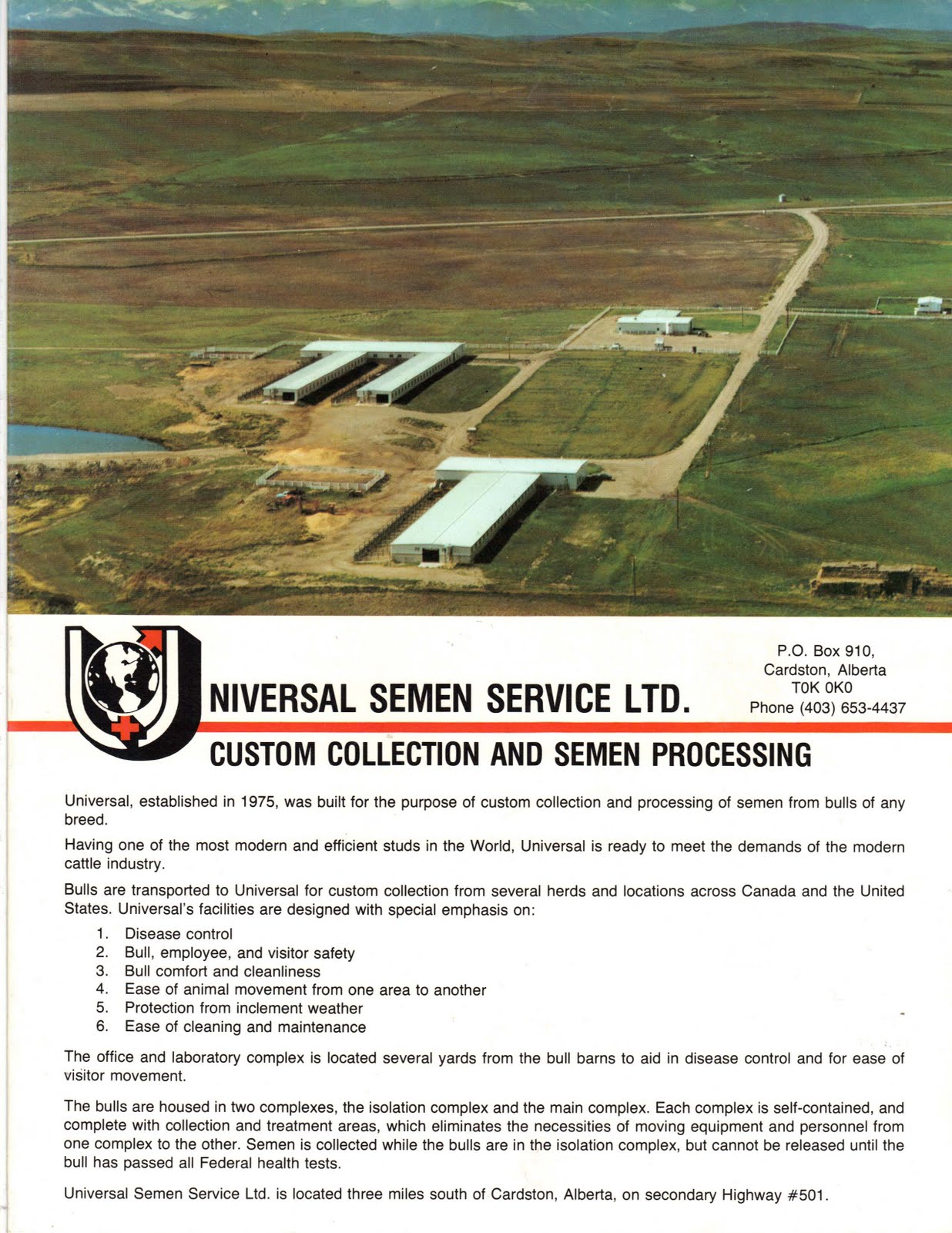
The SBL legacy was also augmented by the construction of Universal Semen Service which developed into one of the best facilities of its kind in the world. Travers, however, never lived to see its best growth.

Also, Travers never lived to see the rough years of 1975 and 1976 when Simmental sales dropped drastically and when SBL was forced to cut back its expansionism. But the down turn was survived by most and Simmental continued its advance—even to this day. And though the golden days of the late 1960’s and early 1970’s will never be repeated, they will ever be remembered with amazement. It was a heady time.

Tuesday, November 29, 2011

Universal Semen Service Ltd.

Meanwhile, despite some internal problems, the work of SBL continued. One on-going concern was to ensure the best possible handling and promotion of their bulls. Because the main focus of private bull studs was often to promote their own bulls, SBL decided in 1972 to build a first-class commercial bull stud that would be available for the top performing bulls in every breed.

This demand for bull studs was fairly new, arising about 1967 with the importation of European bulls. SBL director Frank Smith recalled those days in an interview with the Canadian Livestock Journal (Tue., July 11, 1978):
“Units sprang up overnight because of this demand,” Frank relates, “We had bulls in stud stations in Canada and the U.S.. The quality of the service varied. We became concerned over the safety of the bulls and of the men handling them.” / This sparked the idea of setting up a stud station. This decision was made late in 1972. … / “[As well] poor quality semen results in financial loss to ranchers. We had experienced this ourselves. Our main objective was to produce top quality semen,” Smith affirms. (“Eleven years later Parisien is still making history” by Edgar Bain)
Over the next year, SBL did considerable research. They looked at stud stations in the U.S. and Canada intent on designing a facility that would be unique in construction—focusing on the safety of both bulls and handlers and on the speedy collection of top-quality semen. They found the man they wished to spearhead the project and to supervise construction—Dr. Merlin Gebauer whose doctorate was in reproductive technology.

Construction was begun in 1974 and it began operation in 1975. The result was Universal Semen Service—a state-of-the-art facility located just south of Cardston. Not only did this give SBL both financial and physical control of its valuable bulls, it also provided a much-needed custom facility for other breeders. From “SBL Means Simmental” by Don Sylvester, we read about SBL’s commitment to quality.
Dr. Gebauer says the new stud will emphasize quality control. Owners putting bulls in the stud will have to agree that semen not up to Universal’s standards will not be released. (p. 34)

Friday, June 25, 2010

Building the SBL Herd: Semen Contracts

Meanwhile, SBL set out to acquire a superior crossbred and fullblood herd in the most economical method they could devise. They lit on the idea of semen contracts. In other words, if cattlemen were reluctant to try this new breed, SBL would rent their cows, as it were, and drop the proof in front of their eyes.

From the Beef Today Yearbook ‘ 77, we read:
To get semen out in the country, and to get people using Simmental, semen was put into herds in return for the pick of the heifer calves. Later, more herds were contracted and calves bought back at premium prices. The SBL herd grew from the select picking of these calves. As time went on, however, it was more difficult to get the heifer calves back from the herds, because the herd owners were reluctant to part with them. That was the first and best indication the breed was becoming established. / [SBL Director Fenton Webster recalled] “That was a tremendous job. I remember gathering up over 800 calves in Montana one fall — gathering, weighing and tattooing the whole works.” / … The herd SBL assembled was impressive—the pick of the calves contracted from good commercial herds in the U.S. and Canada. In many cases, it was seeing those females as they developed, that sold breeders on the idea. / “Ed Noad [a prominent breeder] came over one afternoon and saw the herd. He said then — if he had that herd in his pasture — he’d figure he had the best herd in the country.” (BTY’77:85)
As reported in “Eleven years later Parisien is still making history” by Edgar Bain, Travers’ brother Frank Smith said:
“… As early as 1968-69 we started to build up a herd referred to as an upgrade herd. We had a large number of cattle as a genetic base.” / Simmental Breeders Ltd acquired 2,000 head of half blood heifers by purchasing semen contracts. Land was leased and up to 12,000 acres were in use. / “We planned to build up a purebred herd through an upgrade herd,” the S.B.L. director points out, “By upgrading from a broad genetic base we felt we would be able to supply the commercial industry’s needs.” (CLJ:Tue.,July 11, 1978)
 
Creative Commons License
Early Years of Simmental in North America blog by SMSmith is licensed under a Creative Commons Attribution-Noncommercial-No Derivative Works 2.5 Canada License.