Showing posts with label Smith-Frank. Show all posts

Sunday, February 15, 2026

Mountain View School Remembers Parisien Ahead of His 60th birthday


Mountain View School (Grades K to 9) in Alberta Canada held a school assembly on Friday, 13 February 2026 to learn more about the great Simmental bull Parisien (1966 - 1978) and the men who dared dream of making a huge difference in the cattle industry. Four of the long-term shareholders were from Mountain View: Travers Smith, Harold Watson, Franklyn Smith, and Fenton Webster. Another initial SBL shareholder (circa 1966-1971), B.Y. (Young) Williams from nearby Cardston also made a huge contribution to the dream as Travers' first associate in writing to governments and Commissions to arrange for import permits and many other matters.

Don Jensen, Parisien's faithful handler during the touring days of the late 60's and 70s (and now 90 years young) was also in attendance Each of these six men had several descendants in attendance with 5 of them having great-grandchildren (around 20) attending the school. The taxidermy head of Parisien, owned by Don, and recently repaired by local taxidermy specialist, Dave Nelson (grandson of B.Y. Williams), was unveiled. The head was donated to the MV school by Don Jensen through his grandson Brad Sommerfeldt and will soon be hung on a wall in the school library as a reminder to the students of what dreams can accomplish and how they can change an entire industry.

The Parisien birthday celebration was a great event thanks to principal Curtis Leishman, school librarian, secretary, and chief aide-de-camp Lisa Walburger, Don Jensen's family, and many others.

One other Mountain View resident that we mistakenly overlooked to mention was Beatrice Tolley, the amazing secretary, starting in 1969, who kept all the men on track with appointments, record keeping, arranging flights, other travel, etc., etc., etc. Beatrice was the one who coined the phrase "Breed 'em all Simmental" — sometimes rephrased "Breed 'em all SBL Simmental." She was an SBL gem.
The 60th birthday commemoration was held on Friday, February 13
               because Monday the 16th was a school holiday.
            February 16, 1966 was the actual day of his birth.
The Westwind School Division report of the event, written by Genevieve Boyd, WSD Communications Officer, can be found here:
From Mountain View to North America:
The Bull That Changed the Beef Industry
https://www.westwind.ab.ca/about-us/news/post/from-mountain-view-to-north-america-the-bull-that-changed-the-beef-industry
 

Tuesday, November 29, 2011

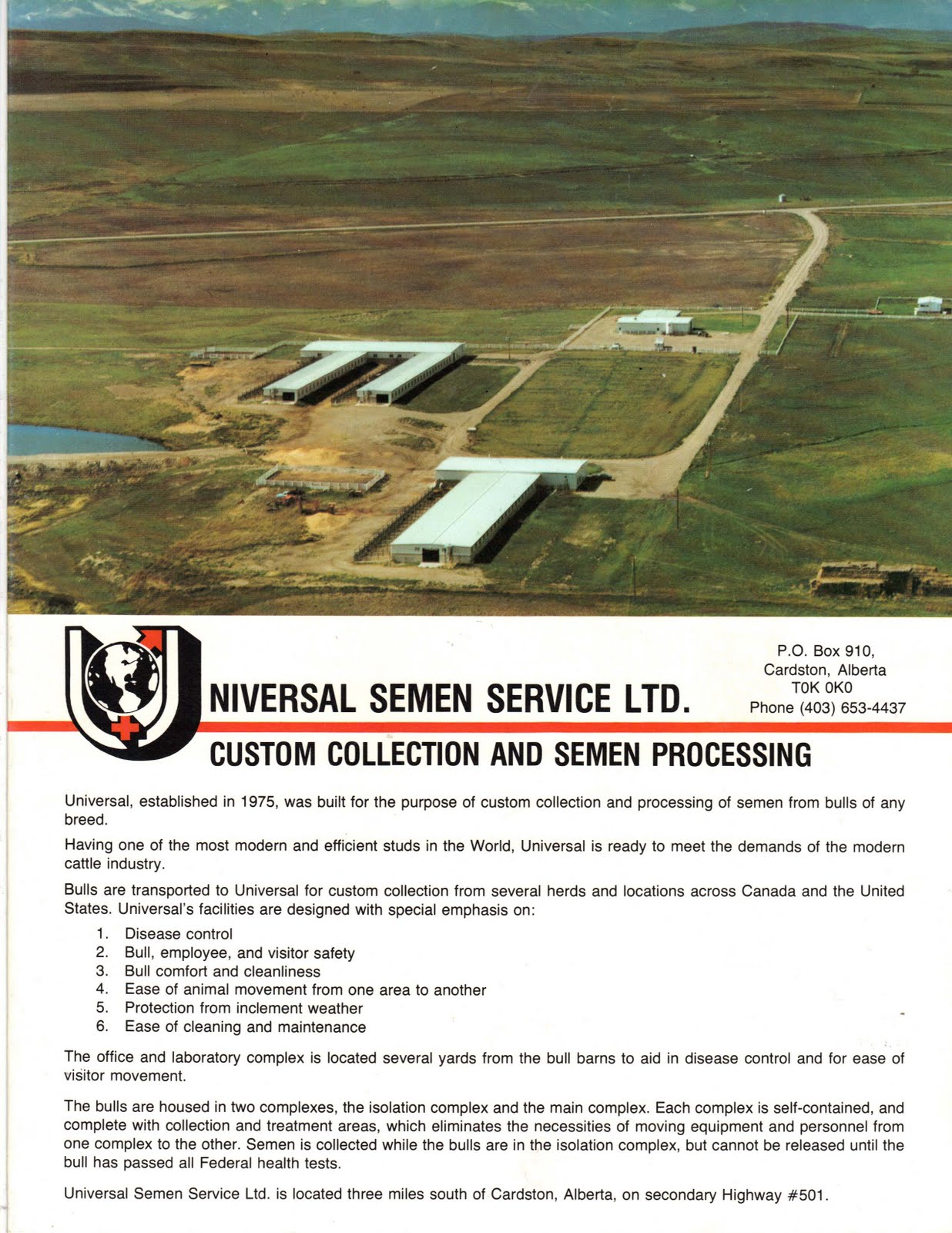
Universal Semen Service Ltd.

Meanwhile, despite some internal problems, the work of SBL continued. One on-going concern was to ensure the best possible handling and promotion of their bulls. Because the main focus of private bull studs was often to promote their own bulls, SBL decided in 1972 to build a first-class commercial bull stud that would be available for the top performing bulls in every breed.

This demand for bull studs was fairly new, arising about 1967 with the importation of European bulls. SBL director Frank Smith recalled those days in an interview with the Canadian Livestock Journal (Tue., July 11, 1978):
“Units sprang up overnight because of this demand,” Frank relates, “We had bulls in stud stations in Canada and the U.S.. The quality of the service varied. We became concerned over the safety of the bulls and of the men handling them.” / This sparked the idea of setting up a stud station. This decision was made late in 1972. … / “[As well] poor quality semen results in financial loss to ranchers. We had experienced this ourselves. Our main objective was to produce top quality semen,” Smith affirms. (“Eleven years later Parisien is still making history” by Edgar Bain)
Over the next year, SBL did considerable research. They looked at stud stations in the U.S. and Canada intent on designing a facility that would be unique in construction—focusing on the safety of both bulls and handlers and on the speedy collection of top-quality semen. They found the man they wished to spearhead the project and to supervise construction—Dr. Merlin Gebauer whose doctorate was in reproductive technology.

Construction was begun in 1974 and it began operation in 1975. The result was Universal Semen Service—a state-of-the-art facility located just south of Cardston. Not only did this give SBL both financial and physical control of its valuable bulls, it also provided a much-needed custom facility for other breeders. From “SBL Means Simmental” by Don Sylvester, we read about SBL’s commitment to quality.
Dr. Gebauer says the new stud will emphasize quality control. Owners putting bulls in the stud will have to agree that semen not up to Universal’s standards will not be released. (p. 34)

Monday, November 28, 2011

Canadian Western Simmental Sale ~ 1973

Just one sale out of many that kept the sizzle in Simmental. The handwritten notes on sale prices were made by Travers.


the consignors on these two pages were SBL and director Frank Smith


Friday, June 25, 2010

Building the SBL Herd: Semen Contracts

Meanwhile, SBL set out to acquire a superior crossbred and fullblood herd in the most economical method they could devise. They lit on the idea of semen contracts. In other words, if cattlemen were reluctant to try this new breed, SBL would rent their cows, as it were, and drop the proof in front of their eyes.

From the Beef Today Yearbook ‘ 77, we read:
To get semen out in the country, and to get people using Simmental, semen was put into herds in return for the pick of the heifer calves. Later, more herds were contracted and calves bought back at premium prices. The SBL herd grew from the select picking of these calves. As time went on, however, it was more difficult to get the heifer calves back from the herds, because the herd owners were reluctant to part with them. That was the first and best indication the breed was becoming established. / [SBL Director Fenton Webster recalled] “That was a tremendous job. I remember gathering up over 800 calves in Montana one fall — gathering, weighing and tattooing the whole works.” / … The herd SBL assembled was impressive—the pick of the calves contracted from good commercial herds in the U.S. and Canada. In many cases, it was seeing those females as they developed, that sold breeders on the idea. / “Ed Noad [a prominent breeder] came over one afternoon and saw the herd. He said then — if he had that herd in his pasture — he’d figure he had the best herd in the country.” (BTY’77:85)
As reported in “Eleven years later Parisien is still making history” by Edgar Bain, Travers’ brother Frank Smith said:
“… As early as 1968-69 we started to build up a herd referred to as an upgrade herd. We had a large number of cattle as a genetic base.” / Simmental Breeders Ltd acquired 2,000 head of half blood heifers by purchasing semen contracts. Land was leased and up to 12,000 acres were in use. / “We planned to build up a purebred herd through an upgrade herd,” the S.B.L. director points out, “By upgrading from a broad genetic base we felt we would be able to supply the commercial industry’s needs.” (CLJ:Tue.,July 11, 1978)

Wednesday, June 23, 2010

Travelin’ Travers

With the first crossbred progeny results in for this “new” breed, Travers and SBL began promoting Simmental anywhere they could get an audience. As noted, the reception seemed better in the United States, for many in Cardston and area seemed skeptical—especially the ones that Travers had envisioned would and could profit most from this venture. He had seen so many of them struggle year after year like himself—like their fathers before—and never seemed to get ahead. And so, in the face of their skepticism and sometimes ridicule, Travers turned his attention to those who were more open, hoping for the time when the local people—the “doubting Thomases”—would see the results and be converted for their own good.

Don Jensen said:
“Everywhere Travers went in Canada, he was met with amusement and people laughed at him, but his perseverance carried him on. He was so dedicated and sincere, you couldn’t help but believe in him. / “He spoke anywhere and everywhere he could get an audience with only the meager material he had on hand. At this time, it was pictures he had taken in Europe and the photos of Parisien as a calf and after quarantine. / “There was scanty information and it was just through his dedication and enthusiasm that he got people to use some semen. The Grass Range Hutterite Colony were the first to breed Simmental outside Travers himself and his brother Frank and this came after Travers showed a bunch of slides on the fridge door and gave them a talk. / … “Travers spoke at the Lions Club in Cardston and one of the first questions asked of him was if he really believed all the things he was saying. Well, I tell you, that was the wrong thing to say to Travers because when he got finished, there wasn’t a dry eye in the place. That’s how dedicated he was.”1
Travers showed slides in public meetings, in hotel rooms, in private homes, on screens, walls and fridge doors. He had a drive and enthusiasm that he had never had before about anything. He was driven by a profound belief in the quality of his product and its potential to improve the lives of thousands of farm and ranch families.

From the article, ‘At SBL They “Breed ‘em all Simmental”’ in Cattlemen, August 1971, we read:
In 1968, as an ambassador of Simmental, Smith visited 20 states in the U.S. where he found an encouraging degree of enthusiasm, and many parts of Canada where the level of enthusiasm was different—in the process he picked up the nickname “Traveling.” (p. 13)
Travers’ pleasure in promoting Simmental was his rest and relaxation. Don Jensen said:
If anybody would listen he’d stay there [promoting] 24 hours a day.
In speaking with Ted Pritchett, Don Jensen recalled how:
Travers would be on that cement for 14 hours a day sometimes until his ankles would swell up so bad he could hardly walk. But he always invited folks back to the room to show them slides and the room was crowded with people almost every night. I’ve never seen anything like it — I don’t know where the man got all his energy, because I never saw him down. Not once in all the years I travelled with him, did I ever hear him wonder if all the work was worth it. He never deviated from his goal and he never lost his dedication.2
In the Simmental Shield, July 15, 1987, Miles McCarry of Curtiss Breeding Service wrote:
All we had to do was “sell” Simmental to people who had never heard of the breed and AI to cattlemen who didn’t want to hear about it. After that, Travers said, Parisien semen would sell itself! … / Travers took a bunch of good slides while he was in France. Later, he got some great shots of Parisien calves. He literally hit the road with them—and with almost missionary zeal. / He traveled wherever grass grew. He spoke at meetings set up by Curtiss distributors. Between meetings, he “talked” his slides in bunkhouses and kitchens. / Travers, to coin a phrase, was the kind of guy you would buy a used car from. His honest enthusiasm sold the Simmental idea—sold it well enough to get a lot of cattlemen “messing” with AI, too. / Net result: Parisien calves started popping up all over the place. People who saw them wanted some just like them. Simmental sizzle! We started to gain momentum! (pp. 1A, 6A)
But even with the frenetic pace of these early days, Travers took time in (January-?)1968 and January 1969 for further education at The Stockmen’s School, sponsored by the Agriservices Foundation and conducted in cooperation with Arizona State University at Tempe. He was always open to new ideas and improved methods.

portion of a news item from the Fort Collins Coloradoan, October 1968
-----------/
1. Simmental Country:Aug1987:37
2. Simmental Country:Aug1987:44

Friday, June 11, 2010

2.06: Swiss Permits ~ at last !!

(From Chp. 2 ~ 1967, titled "The Dream Lives," in a book begun several years ago by SMSmith to document the early history of SBL and Simmental in North America.)

Finally, under date of 19 July 1967, eight permits for the importation of cattle from France/Switzerland were issued to the SBL shareholders, one each to:

Travers Smith; B.Y. Williams; Hans Ulrich
Frank R. Smith; Harold Watson; H. J. Blackmore
O.T. Bingham; S.B. Williams

The telegrams sent July 20 announcing the long-awaited news, prompted a flood of relief. All the hard work, the stress, the aggravations had come to a joyful conclusion. Their selected Swiss calves were still unvaccinated—ready and waiting to enter the first stage of testing and quarantine.

The SBL Importers had not seen any of their selected cattle personally, but they had studied their pedigrees and with the help of Mr. Aegerter, Mrs. Hofer, and Hans Ulrich's father (Hans Ulrich, Sr.) "who did a good job of selection" they ended up with seven more Simmental, 4 heifers and 3 bulls in the works, plus one Brown Swiss, for their eight permits.

Their planning ahead had rewarded them with seven of the eight Simmental cattle imported out of Switzerland that year of 1967/68. The comprehensive vaccination program of the Swiss, plus the delayed timeline left other importers with no place to go but France. The SBL shareholders good fortune in managing to keep their Swiss options open was almost beyond their belief considering the numerous hurdles they had encountered.

Thursday, June 10, 2010

Sampling of communications ~ January-August 1967

▪ Jan 30: Fenton Webster writes to MP David Thompson in Ottawa for assistance in Swiss importation
▪ Jan. 31: Travers receives telegram from CSwissCBF about cattle selections
▪ Feb. 1: FW telephones MP and records notes of conversation
▪ Feb. 6: Letter from CDA-Vets re Swiss. situation
▪ Feb. 9: Letter from CSwissCBF
▪ Feb. 14: Letter from CDA acknowledging request for permit for importing cattle from Switzerland
▪ Feb 27: Letter from CDA re final costs of 1966 importation of Parisien
▪ Mar. 1: Letter from CSwissCBF updating situation on tentative imports
▪ Mar. 2: Letter from Swiss Federal Vets to CDA
▪ Mar. 3: Letter from CDA concerning release date from Grosse-Ile for 1966/67 import, Parisien
▪ Mar. 6: Letter to Travers from J.J. Greene, Canada Minister of Agriculture advising of intended visit of Senior Veterinary official’s visit to Switzerland and France in early May.
▪ Mar. 7: CDA Letter to Swiss Federal Vets concerning importation matters
▪ Mar. 8: Letter from CDA acknowledging receipt of Travers’ permit request for “three head of Simmental cattle from Switzerland in 1967 ....”
▪ Mar. 10: Letter to CDA re concerns about delayed release of 1966/67 imports
▪ Mar. 14: Letter from CDA replying to Mar. 10 letter
▪ Mar. 18: Swiss Federal Vets letter to CDA
▪ Mar. 21; CDA letter to Travers re on-farm quarantine protocol
▪ Mar. 23: CDA letter to Travers re his March 16 query about possible Ag. Research interest in Simmental
▪ Mar. 29: 2nd page of CSwissCBF letter to Travers re progress update
▪ Apr. 28: CDA-Vets letter to CswissCBF advising of delayed visit and acknowledging complications that it creates for Switzerland and importers
▪ May 2: Letter to Travers from CDA advising that a final decision had not been made, but accompanied by a 7-page “1967 Conditions for the Importation of Cattle from France, Switzerland approved by the Veterinary Director General, Health of Animals Branch, Canada Department of Agriculture
▪ May 11: Letter to CDA from CSwissCBF about May 15 visit and attempts to delay vaccination of selected cattle
▪ May 16: CDA reply to above
▪ May 16: Letter from CDA to Alberta Vet re insemination protocol of quarantined animals
▪ Jun 22: Letter from CDA to Travers re the “group” import requests
▪ Jul. 19: Permit letters for importation to Travers, B.Y. Williams, Hans Ulrich, Frank R. Smith, Harold Watson, H.J. Blackmore, O.T. Bingham, S.B. Williams; and copy of actual permit issued to “Mr. Travers Smith”
▪ Jul. 20: Telegram to Travers advising of import permit
▪ Aug. 25: Letter from S.E.P.A. re Parisien registration papers

Friday, June 4, 2010

SBL Shareholders

This photo, probably taken in the early 1970s, shows the long-term shareholders of SBL.

 Back row, L to R: Travers Smith, Harold Watson, Frank Smith, Fenton Webster // Front row: Hans Ulrich, Dale Lynch
Photographer is unknown at this time.

Saturday, May 29, 2010

1:13: SBL (Simmental Breeders Limited)

(From Chp. 1 ~ 1966, titled "Foundation Work," in a book begun several years ago by SMSmith to document the early history of SBL and Simmental in North America.)

Another priority that summer and fall of 1966 was to organize the group of local investors who had responded to Travers' enthusiasm as he described what he envisioned the Simmental breed could do to increase productivity, performance, and profitability in their livestock operations. By August 1966, seven men had committed to help Travers finance this venture that had so captured Travers' focus. On August 30, six of the eight initial contributors of capital met to determine the type of organization they would establish to transact the future business of the contributing group. Those present at the meeting were:

B. Travers Smith; Dr. Orson T. Bingham; Harold Watson; Guy Bowlby; H.J. Blackmore*; B.Y. Williams

Those absent were: Dr. S. B. Williams; Franklyn Smith

Each contributor's investment was $500.00 in cash with a further $500.00 guarantee to the bank for a $4,000.00 loan.

The name of the company was determined to be Simmental Breeders Limited,1 and direction was given for its incorporation which took place on September 26, 1966.

Chairman: B. Travers Smith
Secretary; B.Y. Williams

Dr. Orson T. Bingham was a Cardston dentist who ran cattle on the side.
Harold Watson was a rancher with some farming interests who lived at Mt. View and was brother-in-law to Travers Smith.
Guy Bowlby was a rancher living at Twin Butte, AB.
*J.H. (James Horn) Blackmore (aka-Hastings James or H.J.) was a cattle rancher based in Leavitt & Mountain View
B.Y. Williams was manager of the Cardston Credit Union and rancher.
Dr. S.B. Williams was a Cardston dentist, with cattle interests on the side.
Frank Smith was a cattle rancher at Mt. View, AB, and brother to Travers.

There were others that Travers invited to join the venture, but who, for various reasons, were not ready, willing, or able to take the risks that certainly attended such an investment. This new breed of cattle was essentially unheard of in North America. For some, the performance facts of Simmental seemed to-good-to-be-true. If the Simmental were so good, why hadn't someone found a way to get them in long ago? The fact they were not in North America when their reputation for quality and performance were so widely and anciently recognized throughout the rest of the world was amazing to Travers, too. It seemed impossible that no one had found a way to get them here.

The first SBL logo was adopted about 1970.

(Phone and address are not longer valid as company no longer exists.)

---------/
1. On 25 July 1969 the company's name was changed to Simmental Breeders Cardston Limited, but it would always be known as SBL. (Ref.: Alberta corporate registry search).

Friday, May 7, 2010

The Year It [Simmental] All Began in North America ~ 1966

[This 1966 timeline was researched, compiled, and written by S.M. Smith, daughter of B. Travers Smith, with reference to articles written by Travers Smith, as well as from original letters and carbons of letters—some of which are reproduced hereafter. Note: Quotations from Travers’ letters preserve his random capitals, haphazard punctuation, and carefree spellings.]

January
Travers Smith, age 49, of Mountain View, Alberta Canada, begins his 20th year of running the family ranch that his grandfather had homesteaded in 1899/1900. In the first week of what will prove an astonishing year, Travers’ long-held passion to improve his cattle herd leads him to read a 1964 report by Hobart F. Peters about Peter’s travels in Europe to study animal breeds, including the Simmental. (Peters is a geneticist with the Lethbridge Research Branch of the Canada Department of Agriculture—CDA.) This is Travers’ first encounter with the word Simmental. He quickly encounters it again in another article and in conversation with Charlie Redd of La Sal, Utah.

January–March
Everything Travers reads and hears about this “new” old breed sets him on fire and he becomes a man with a Simmental mission. He recruits his uncle’s business associate, B.Y. Williams, to help with correspondence to the Canada Department of Agriculture (CDA) and to the Commission of Swiss Cattle Breeders’ Federation.

February 16
A bull calf is born on the Henri Rossin farm (C 982) at Saint-Appolinaire, Cote d’Or, near Dijon, France. Someone names the new calf, Parisien. No one knows the revolution he will initiate, the 100,000 plus miles he will travel, the penthouse ballrooms he will parade through, or the genetic heritage he will bequeath to over 15,000 progeny. He is just an exceptionally fine calf with good prospects—technically French Pie Rouge, but the equivalent of the Swiss Simmental. In fact his sire was a Swiss Simmental, Lausannois (15721) and had been imported from Switzerland to France. His dam was French Pie Rouge named Uree-Etoile (82-876). 

April 04
Travers and B.Y. Williams write to the CDA expressing interest in importing the “Red and White Simmental” of Switzerland.

April 30
After becoming aware that Switzerland is firmly closed for direct importation because of animal health restrictions in Canada, Travers directs a written request to the CDA for “the number of Red and White Simmental cattle allowed under one permit” for importation from France.

May/June
Travers continues correspondence with the Swiss Cattle Breeders’ Federation, firmly convinced that Switzerland can be opened for direct importation if Swiss and Canadian officials will just jump through enough hoops to make it happen.

June 29
Anxiety mounts as no word comes from the CDA regarding the permit request, so the duo fire off another letter to the CDA. B.Y. Williams remembers it thus:
[A few] days later Travers got a telephone call from Ottawa with apologies and the information that, due to an error, his permit application had been overlooked but had been granted. He had until August 8 to have his calf in farm quarantine in France. Not much time. Five thousand bucks quick, and something to back it up, and a bull required within less than six weeks. We had no problem with money at the time, not having any. We just decided to raise five hundred dollars each and get the same amount from a like number of friends, and we were in business. / Travers had contacted Charley Redd previously and he had said, “If you ever get a permit, I want to pick the bull for you.” So Travers got on the phone. No dice. Charley Redd’s calendar was full. So Travers booked the next suitable reservation he could get for Berne, Switzerland. Switzerland wasn’t open at the time for export, but he wanted a look at the native breed in the country of their origin. (SSh:March1974:30)
July 07
The “overlooked” CDA permit for the “importation of 1 cattle from France” is mailed to Travers. The date of its receipt is not recorded, but time is of the essence because an unvaccinated bull calf under 9-months of age must be in the system no later than August 8. (An approximate 30-day on-farm quarantine is required before the Brest, France quarantine which is set to begin September 1.)

July 27
Travers boards his first-ever air flight in Lethbridge, Alberta bound for Zurich, Switzerland trusting that he can get his passport during a 5-hour stopover in Ottawa. Delays en route reduce his time in Ottawa to 3-hours, but he gets his passport and somehow finds time to also obtain “some good leads” for French contacts from the CDA Vets and from Trades and Commerce in Ottawa.

July 29
After a major airline delay in Paris, Travers arrives in Zurich and takes the evening train to Berne, arriving at 9 P.M.—7 hours behind schedule.

July 30
It is Saturday and the Swiss Cattle Federation office is closed, but Travers manages to roust a young man in the building who helps arrange a cattle guide—a Mrs. Hofer from Spiez—who takes Travers on a tour of the Simme River Valley. Travers writes home the following day, “The most Magnificant Cattle I have ever seen.” He will later recount
I spent some hours with a tape measure measuring these cattle and jotting down the figures and just standing and looking at them. It took some time to pull myself away from this scene. (SSh:Oct1970:8)
July 31
Travers attends Church services, visits with a new acquaintance, Dr. Winzenried on his farm near Berne, and writes to B.Y. Williams:
I can’t get over them. We can’t get this kind of animal in 100’s of years of breeding with what we’ve got to work with in Canada. If we can get a few over home it will be the biggest break through for Cattle in a long time. … I’m making every effort and contacted [sic] possible to see if we can’t move cattle from here to France for another year. // … I would sell ½ my herd to get a few of these over. (BYW-2:July31/1966)
August 01
Travers proceeds to Geneva; meets and travels with Mr. Roger Decre, a French cattleman from Gex, who is an importer/exporter between Switzerland and France; spends the entire day with Mr. Decre (and Decre’s cousin who serves as interpreter); and then takes the night train to Paris.

August 02–06
After spending the morning at the Canadian Embassy getting contact information, Travers arrives in Dijon at 3 pm on August 2:
Met Mr. Plenat at Pie Rougue Cattle registry. he had interperater told him what I was looking for. he said to get hotel and by morn would have a list of men to see. Just as I was ready to leave Wayne Malmberg called from Nevers. He & Ray Woodward had done a lot of ground work on these cattle for me and were ready to come up with the S.E.P.A. [Société d’Exportation de Produits Agricoles] Men next morning. Next day [Wed., Aug. 3] we had 2 cars Good top men Knew Country & Cattle, we saw some Good cattle. Had a good visit with Wayne and Ray Woodward who is one of best Genetists in U.S. He helped develope the Line 1 Miles City Cattle we bought. Travelled 500 Miles and landed back at Nevers. Next day [Thursday, August 4] saw some Good Charlaise Cattle Sepa Men contacted more men [p. 3] and next day [Friday, August 5] went back North of Jidon [Dijon] Saw more good Simmintal. Picked 3 Calves to test, One has to have at least 3 to start with for some fail on health tests. Made all arrangements with S.E.P.A Organization on cattle next day [Sat., August 6]. They will handle everything to Brest France the Quarantine Station. We only pay them at end of test for the bull that gets on boat for Canada. Wayne & Ray Left for Canada Thursday [Aug. 4] I missed train for Berne Swiss Last night so am travelling today Sunday to Berne. be at sacrament meet[ing] there tonight. Want to see more cattle in Switzerland. Then back to Paris Friday [August 12]. have a reservation for Plane Sat. be home Sunday I hope. … (BFS-6:Aug7/1966)
The S.E.P.A. document dated 6 August 1966 lists Travers’ first choice as Parisien, with a farm price of 17.000 Fr. (See October 21 entry below.) Two alternate choices are required in the event that Parisien fails the health tests. The first alternate, Orkan, is from the Langenieux farm; the second, Oranais, from the Roger farm. First-choice Parisien is found a mere five miles from the Herd Book Office of the Pie Rouge at Dijon. With the S.E.P.A. documents signed, the animals with their dams were set to enter the requisite testing area on Monday, August 8, 1966—the deadline given by the CDA. Travers had beaten the deadline by one day, a Sunday. Things were now in process, being superintended by the well-organized Canadian Charolais Association (CCA), acting as agent for all Canadians importing from France. Everything will proceed like clockwork from one stage of testing and quarantine to the next.

August 07-12
Travers returns to Switzerland and spends his time:
… making arrangements for the future, contacting all the government and export people possible, as well as their veterinarians. My inquiries for top quality cattlemen in Switzerland to do a selection job for us in the future led me to two persons—Ernst Aegerter, who had for most of his life headed up the export of cattle out of Switzerland, and a Mrs. Ida Hofer, who was a real cattlewoman in her own right, being of a famous cattle breeding family in Switzerland and also married into one. (SSh:Oct1970:9 from “Selecting the first Canadian Simmentals,” by Travers Smith, Simmental Shield, October 1970, pp. 8-10.)
August 15 onward
Upon returning home, Travers continues his telephone and letter campaign hoping to get Switzerland open for importation to Canada. At the same time, he begins directing cattle selection in Switzerland through his two Swiss contacts (Aegerter & Hofer), trusting in their expertise and trusting that the Canadian government will open Switzerland for the upcoming importation year. (This will prove a nail-biting experience for these first Canadian Simmental believers and investors. When at last it seems too late, they will receive eight permits for France/Switzerland, dated July 19, 1967.)

Travers’ long-suffering bankers have not been overly impressed with his latest idea, so in order to finance the Simmental “gamble,” several local investors finally respond to Travers’ enthusiasm. His vision of what the Simmental breed can do to improve productivity, performance, and profitability in livestock operations somehow slips into every conversation. By late August, seven men commit to help Travers finance this venture that has so captured his focus.

August 30
Six of the eight initial contributors of capital meet to determine the type of organization they want to transact the future business of the contributing group. According to the minutes, those present at the meeting are: “B. Travers Smith; Dr. Orson T. Bingham; Harold Watson; Guy Bowlby; H.J. Blackmore; B.Y. Williams.” Those not able to attend are: Dr. S. B. Williams and Franklyn Smith. Each contributor’s investment is $500.00 in cash with a further $500.00 guarantee to the bank to secure a $4,000.00 loan. Thus, their working capital for the project is $8,000.00. Their Parisien venture will take almost all of it.

September 20 (abt)
The Canadian Charolais Association advises that some testing delays have occurred and that “present plans are to move the cattle from the farms to Brest quarantine station within the next few days. It is expected that the plans will then be pretty much as scheduled, arriving at Grosse Ile, late October.” (Undated CCA letter to importers)

September 25
Parisien goes into quarantine at the Brest Quarantine Station in France. (S.E.P.A. letter dated September 28, 1966)

September 26
Simmental Breeders Limited (aka, SBL) is incorporated with B. Travers Smith, chairman; and B.Y. Williams, secretary with the remaining investors as directors.

October 21
The Royal Bank of Canada receipt of this date shows a currency exchange of .22, resulting in a total cost of $3,630.00 Canadian dollars that Travers and his fellow investors send to finalize matters with S.E.P.A. In subsequent correspondence by Travers, it appears that the original farm price for Parisien was 15.000 Fr., but is increased to 17.000 to cover extra costs relating to the transport, testing, etc. of the two alternate bulls at 1.000 Fr. each. Only one of the alternate bulls with dam is delivered to the testing area, so the adjusted price paid is 16.500 Fr. The extra 500 Fr. is for transport costs to get Parisien to Brest, France after he passes the first tests.

October, late [29th]
After a period of quarantine at Brest, France, Parisien and 228* other imports (mainly, if not totally, Charolais) are loaded onto a cattle boat for the 8-day ocean voyage to Grosse-Ile, Quebec—Canada’s quarantine facility in the Gulf of St. Lawrence. Here, Parisien will spend his first Canadian winter. (*CDA letter of Sept. 15, 1966 states cattle imports authorized for 1966 total 229.)

December
This pivotal year ends with Parisien’s anxious owners looking forward to an early spring thaw so their “great expectation” can wend his way to the Canadian mainland and overland to Alberta for his last quarantine phase—a 90-day on-farm quarantine on Travers’ ranch. In Travers’ view, things are looking up for every farm and ranch family in North America—every family, that is, who will lend him their ears and their eyes for even just a minute.


Those of you who remember Travers knew him as a man of deep faith. In a letter to his children in 1971, he wrote of this first Simmental trip, saying “… the Lord softened the heart of a customs man that I got a passport after [brief] hours in Ottawa. He led me to the right people in Switzerland, in France; unbeknown to them He influenced men to organize trips for me to see cattle. He gave me ideas and understanding of Cattle and the attendant business far beyond my natural powers. In the past He prepared through men’s management of Genetics, a Bull that started the biggest revolution for good in the cattle industry on this continent.”

And it all began—a mere 40 years ago [now 44].

[The above Timeline, written by SM Smith, was first published in Simmental Country, June/July 2006, World Congress Special Edition, pp. 120-128.]
--------------
Note: this author is aware that Simmental was referenced in North America in the late 1880s and early 1900s, but did not survive as a distinct breed here, thus Simmental became one of the "exotics" in the heady days of the 1960s and '70s.
 
Creative Commons License
Early Years of Simmental in North America blog by SMSmith is licensed under a Creative Commons Attribution-Noncommercial-No Derivative Works 2.5 Canada License.