
 |
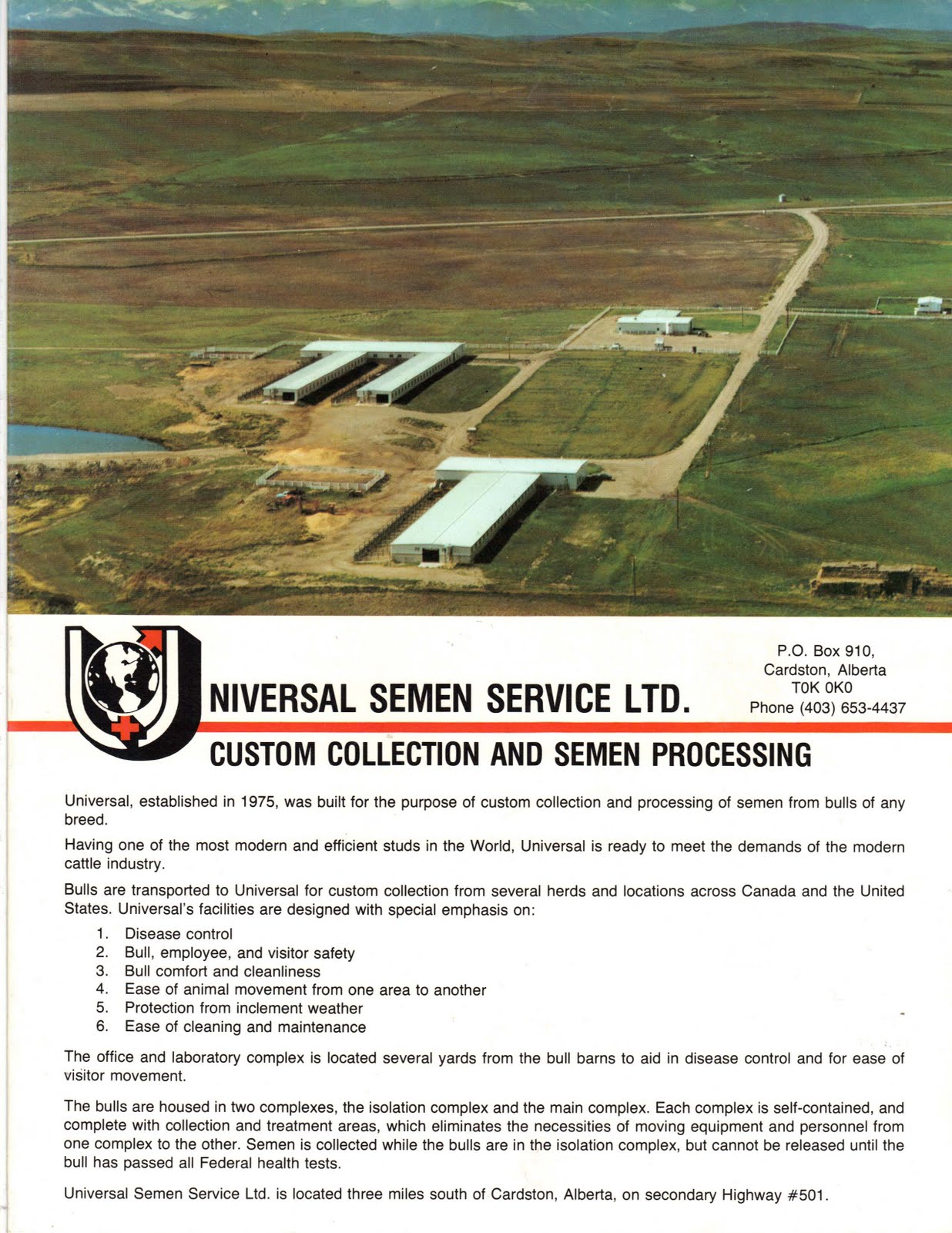
| an early USSL flyer |
Showing posts with label Promotion. Show all posts
Showing posts with label Promotion. Show all posts
Friday, December 9, 2011
Wednesday, December 7, 2011


Monday, December 5, 2011

Tuesday, November 29, 2011
Universal Semen Service Ltd.
Meanwhile, despite some internal problems, the work of SBL continued. One on-going concern was to ensure the best possible handling and promotion of their bulls. Because the main focus of private bull studs was often to promote their own bulls, SBL decided in 1972 to build a first-class commercial bull stud that would be available for the top performing bulls in every breed.
This demand for bull studs was fairly new, arising about 1967 with the importation of European bulls. SBL director Frank Smith recalled those days in an interview with the Canadian Livestock Journal (Tue., July 11, 1978):
Construction was begun in 1974 and it began operation in 1975. The result was Universal Semen Service—a state-of-the-art facility located just south of Cardston. Not only did this give SBL both financial and physical control of its valuable bulls, it also provided a much-needed custom facility for other breeders. From “SBL Means Simmental” by Don Sylvester, we read about SBL’s commitment to quality.

This demand for bull studs was fairly new, arising about 1967 with the importation of European bulls. SBL director Frank Smith recalled those days in an interview with the Canadian Livestock Journal (Tue., July 11, 1978):
“Units sprang up overnight because of this demand,” Frank relates, “We had bulls in stud stations in Canada and the U.S.. The quality of the service varied. We became concerned over the safety of the bulls and of the men handling them.” / This sparked the idea of setting up a stud station. This decision was made late in 1972. … / “[As well] poor quality semen results in financial loss to ranchers. We had experienced this ourselves. Our main objective was to produce top quality semen,” Smith affirms. (“Eleven years later Parisien is still making history” by Edgar Bain)Over the next year, SBL did considerable research. They looked at stud stations in the U.S. and Canada intent on designing a facility that would be unique in construction—focusing on the safety of both bulls and handlers and on the speedy collection of top-quality semen. They found the man they wished to spearhead the project and to supervise construction—Dr. Merlin Gebauer whose doctorate was in reproductive technology.
Construction was begun in 1974 and it began operation in 1975. The result was Universal Semen Service—a state-of-the-art facility located just south of Cardston. Not only did this give SBL both financial and physical control of its valuable bulls, it also provided a much-needed custom facility for other breeders. From “SBL Means Simmental” by Don Sylvester, we read about SBL’s commitment to quality.
Dr. Gebauer says the new stud will emphasize quality control. Owners putting bulls in the stud will have to agree that semen not up to Universal’s standards will not be released. (p. 34)


Thursday, November 24, 2011
SBL Field Day ~ 1973
From “Simmental Breeders Hold Field Day” by Leland Cade in the Sept. 6, 1973 issue of the Montana Farmer-Stockman we read:
The following map is from an old printer's draft and was used in some of SBL promotional material.

Simmental Breeders, Ltd of Cardston, Alberta had a big field day recently — 600 people from quite a few states and provinces registered to view the animals, listen to speakers, take part in a big beef feed, and check their numbers for the big door prize — a half-blood Simmental heifer bred to a Simmental bull or a trip for two to the homeland of Simmental (Switzerland) plus $1,000.00 cash for incidentals.SBL was already working on developing its own bull stud. It would become know as Universal Semen Service Ltd.
Winner of the prize was Janna McMahon of Kennewick, Washington. …
Dr. Jim Wiltbank of Colorado State University was introduced as “playing a fundamental role in the development of SBL.” During the presentation he said that “Our fundamental purpose is three-fold — to identify superior Simmental bulls, to make use of these bulls in our program, and to make those bulls available for your use. … (pp. 46-7)
The following map is from an old printer's draft and was used in some of SBL promotional material.

Tuesday, November 22, 2011
Swiss Cattle Breeders ~ Promotions
For a few years, Travers acted as the official Canadian representative of the Commission of Swiss Cattle Breeders Federations as they promoted the benefits of this new “very old” breed. Two of their ads are shown below. The publications are unknown, but believed to be from the years 1972 and 1973.
 |
| circa 1972 (?) |
 |
| circa 1973 |
Monday, November 14, 2011
Show Circuit ~ Summer/Fall 1971
The hand-written notes are in Travers’ handwriting and perhaps indicate potential or actual attendance numbers at each show.


More Travels & Promotion
Travers continued his trips to Switzerland to research and select cattle as import permits were issued. Three of the trips that can be documented are:
The Simmental Scene, March 1974 gives some idea of the passion Travers had for Simmental.
June / July 1970 – France, Switzerland, and Germany. (Post Card: June 26/70, & Passport: July 1, 1970)Travers’ greater contribution, however, was as he travelled from town to town and farm to farm in both Canada and the U.S. promoting the remarkable Simmental. He also attended many events at which he often spoke. He was a regular attendee at the annual meetings of both the American and Canadian Simmental Associations, ranging from Denver to Fort Worth to Regina Saskatchewan and beyond.
June / July 1972 –Switzerland, Germany, and England with Hans Ulrich. (MSA Newsletter: June 27, 1972)
April / May 1973 – France and Switzerland on cattle business (accompanied by three of his children).
The Simmental Scene, March 1974 gives some idea of the passion Travers had for Simmental.
… After the arrival of Parisien in 1967, Travers devoted endless hours, days and weeks to the promotion and development of Simmental throughout North America. It was because of his tireless efforts that the nickname Travelling Travers was tacked on this forceful, dynamic man. Wherever Travers could find someone who would listen, he expounded on the value of Simmental. He presented talks all over the continent; around kitchen tables with pictures projected on the wall to mass meetings with several hundred in attendance. Travers was instrumental in the formation of the Canadian Simmental Association and was one of the men whose signature appears on the application for incorporation under the Canada Pedigree Act. Travers served as First Vice President on the first [interim] Board of Directors and on August 2nd, 1969 was elected President of the Canadian Simmental Association. He served as a director for three years. (p. 13)
 |
| SBL ad from Simmental Shield magazine, October 1971 |
Wednesday, November 9, 2011
Performance Reports ~ 1970
The 12-page SBL promo brochure for circa 1970 was full of b&w pictures and performance stats. Here are pages 8-11:


Monday, November 7, 2011
Words in Print
 |
| B. Travers Smith June 2, 1972 |
In the Simmental Shield article, Travers wrote:
Our story has grown as we have traveled from place to place and met with ranchers with down-to-earth experiences, and spent from one hour to three hours at each meeting, sometimes with one man, sometimes with 40 or 50. In meetings with college and university students there have been upwards of a hundred in a group. Future Farmers of America and 4-H groups with their leaders, the university groups and their professors along with them, all seem anxious to hear the story and take the good tidings to someone else. One meeting we remember in particular was held at Augusta, Mont. where 30 ranchers met together for three hours. At the end of the meeting, one of the ranchers said that it was the best time he had had in years. We picked up a lot of good, practical information from management practices of ranchers and other experiences told at meetings and to others.For a time, SBL also produced a newsletter about the successes of Simmental. SBL’s belief in the value of Simmental was borne out time after time in performance testing programs, as well as in carcass weights. Several grand and reserve championships were won by 4-H members and by others who participated in showring and other competitive events.
So our story has grown—not just on Simmental alone, but a story of the cattle industry and how we can improve it from one end to the other. ...
We have also been privileged to tell the story at other conventions of cattlemen, such as P.R.I. at Sheridan, Wyo.; on two occasions at Dr. Ensminger’s Beef Science School in Phoenix; a program shown at the Curtiss booth at the livestock show in Denver; Western Stock Growers’ Convention at Calgary, Alta., and a Beef Science School at Banff, Alta. We have also given presentations at A.I. technician schools back and forth across the land, but most of all the story has spread by word of mouth. People have seen the calves that have been dropped from Simmental matings with almost every breed you can imagine in the United States and Canada – from Austin Rugge’s Shorthorn cows at Garnett, Kan., to Adam Schweitzer’s Simmental-Hereford crosses at Geyser, Mon. People have seen our own calves here in southern Alberta, the purebred heifers here, and also the bulls at the A.I. studs.
All of these things spread the story, and it keeps being told over and over. We are so enthused over the possibilities of this breed that we will keep telling the story, and those who have calves on the ground and others who are interested will continue to tell the story for us. (p. 10)
Friday, November 4, 2011
A Good Investment
Because Travers’ reception in his native country of Canada was so skeptical and cool in the beginning, most of his efforts had been focused on promoting Simmental in the United States where the cattlemen seemed ready for change. But as the winds of this new phenomenon began to blow northward, the Canadians finally caught on and “Exotic” became the watchword. Those impressive calves on the ground could no longer be ignored. As Ted Pritchett put it:
By October 21, 1971, a statement of assets set forth a value of $4,800,000.00 for SBL assets which is all the more remarkable considering that SBL was just 5 years old—and that initial investors had bought in for $500.00. One old cowboy in the Pincher Creek, Alberta area who had rejected Travers’ call to invest lamented some years later:
For semen sales, the golden year was 1970-71. Travers went on the road selling semen and total sales were over $1 million that year. Everywhere, cattlemen, that had for years scorned crossbreeding, AI and any hint of a change of breeds, were jumping in. Much of it was to take advantage of the unbelievable prices being paid for the halfblood females, but many were drawn for the same reason which drew Travers and his original followers to the breed. There was a definite economic advantage to crossbreeding with these cattle and it meant more money in the fall at sale time. (BTY’77:87)SBL had proven a valuable investment even in the space of a few short years. Four of the initial investors, Williams, Williams, Bingham, & Bowlby had had a falling out early on and in the buy-out of their shares negotiated in 1970 (paid in semi-annual installments from 1970 to 1974), some received upwards of a 270-fold increase on their initial $500.00 investment. (Ref: BTS notes)
By October 21, 1971, a statement of assets set forth a value of $4,800,000.00 for SBL assets which is all the more remarkable considering that SBL was just 5 years old—and that initial investors had bought in for $500.00. One old cowboy in the Pincher Creek, Alberta area who had rejected Travers’ call to invest lamented some years later:
Can you imagine! I could’ve been a part of Parisien for 500 bucks. A million dollar bull and I could’ve been in on it for $500.00. (BTY’77:78)Ted Pritchett wrote:
Today, Simmental is a “rags to riches” story — the Cinderella of the cattle industry. Starting in 1967 it was laughed at, put down and even during the boom years, told the bubble would burst and it would be left sitting in the cold. The fledgeling Association, started on a shoestring in 1969, has grown in a few short years, to become the fastest growing breed Association in Canada. (BTY’77:87)About this rapid growth, Don Jensen is quoted as saying:
When I started working for Travers, I really didn’t know who was going to sign my first paycheque and in the space of three years, the outfit had grown to an operation with 10,000 acres and 300 cows. (SC:Aug1987:44)Jack Ball wrote:
It was a time we’d never seen before and doubt if I’ll ever see again. Every one was buying “time.” Everyone was trying to get the first ½ blood, the first ¾, then the first Purebred … / … it was the most changing and exciting time. Many, many new products and techniques which we take for granted today were developed at that time. For example, how many rubber ear tags, goose neck trailers and embryo transfers did you use before 1967? (SC:Aug1987:114)In part, because of Travers’ aggressive approach to grasping opportunities as they came, SBL soon had in excess of 12,000 acres of leased and deeded land with 25 employees and 2,000 head of cattle. (Ref: CLJ:Jul11’78-Bain & SC:Aug1987:44)
Thursday, November 3, 2011
On Tour ~ The Show Circuit
One of the great SBL promotional tactics was to tour Parisien to the various shows where his impressive size and unique appearance were guaranteed to attract attention. Don Jensen, SBL’s first employee and a man whom Travers greatly admired for his expertise and dedication, was Parisien’s chief handler. Don, a fine cattlemen in his own right, logged tens of thousands of miles with Parisien. With all the travelling required, Don sacrificed much in the cause of Simmental and the SBL men were immensely grateful for his loyalty and dedication.
The premier showing in the U.S. took place in December 1969, when Don and Parisien travelled to the 1st Annual International Cattlemen’s Expo in Las Vegas. In January 1970 they continued on to the Arizona National Show in Phoenix; and the National Western Show in Denver. (ref: BBB:Nov1969:3; WLJ:Jan.1970:68; CU:Dec.1969) The circuit took them also to Dallas, Fort Worth and many other places. The most convincing part of the Simmental story was told by Parisien himself. Fenton Webster recalled:
The Phoenix Gazette of January 1970 reported on this first tour as follows:
Don and Parisien were on the road again in the summer of 1971. From Travers’ Daytimer, we read that on August 25, 1971, Parisien cleared the border on his way to Colorado.
Although Parisien got much of the press, other SBL bulls, like Gallant, Granit and Mars, as well as some females, were also taken on some of the show circuits, usually accompanied by Don Jensen. A listing of the SBL Show Circuit for 1971 shows that between August and November, bulls were shown at major fairs in Montana, Iowa, South Dakota, Nebraska, Kansas, Oklahoma, Texas, and Wyoming.
From two interviews with Fenton Webster and Don Jensen, respectively (reported and written by Ted Pritchett), we read:
There were others also, besides Don & Travers, who did some touring and promotion at the shows and meetings: chiefly, Fenton Webster, Harold Watson, and sometimes Dale Lynch.
The premier showing in the U.S. took place in December 1969, when Don and Parisien travelled to the 1st Annual International Cattlemen’s Expo in Las Vegas. In January 1970 they continued on to the Arizona National Show in Phoenix; and the National Western Show in Denver. (ref: BBB:Nov1969:3; WLJ:Jan.1970:68; CU:Dec.1969) The circuit took them also to Dallas, Fort Worth and many other places. The most convincing part of the Simmental story was told by Parisien himself. Fenton Webster recalled:
That first year, in Denver [at the National Western Show], there were hundreds of people going by the main pathways. Hereford and Angus breeders would go by in a big group. You could spot them coming by their badges and hat bands. They’d laugh and poke fun, but later they’d come back, one by one, to have a closer look and ask questions. Travers could really get that job done, because he was about as converted a Hereford man as you could find anywhere.1As the enthusiasm for Simmental spread, it was not long before Parisien found himself being transported via freight elevators up to the top floors of grand hotels where he would be escorted into packed ballrooms of cattlemen—to be gazed upon by the admiring and awestruck dinner guests. It was the beginning of an incredible golden age in the cattle industry.
The Phoenix Gazette of January 1970 reported on this first tour as follows:
NEW BREED FOR U.S.Simmentals To Be Seen At Livestock Show HereAt year’s end (1970), they were again at the International Cattlemen’s Expo in Las Vegas, and in January 1971, they continued on to other shows and events such as the ASA 3rd Annual Convention in Denver where Parisien was a star attraction. By February they were at the Fort Worth Stock Show, the San Antonio Stock Show & Rodeo, and the Houston Show. Travers’ second son travelled some on that circuit and received page 2-F coverage in the San Antonio News of Friday, February 19, 1971. The report claimed that 5-year-old Parisien had netted SBL some $1,200,000.00 in semen sales since he was purchased in France in 1967 [1966].
When they tell you there's something new at the Arizona National Livestock Show Jan. 5-11 … you’d better believe it.
It’s a brand-new breed for U.S. shows … the Simmental.
Harold Watson, a director of the Simmental Breeders of Cardston, Alberta, Canada, was the first arrival for the 1970 show yesterday at the fairground.
He brought along three head of pure-bred stock and two cross-bred heifers. …
Don and Parisien were on the road again in the summer of 1971. From Travers’ Daytimer, we read that on August 25, 1971, Parisien cleared the border on his way to Colorado.
Although Parisien got much of the press, other SBL bulls, like Gallant, Granit and Mars, as well as some females, were also taken on some of the show circuits, usually accompanied by Don Jensen. A listing of the SBL Show Circuit for 1971 shows that between August and November, bulls were shown at major fairs in Montana, Iowa, South Dakota, Nebraska, Kansas, Oklahoma, Texas, and Wyoming.
From two interviews with Fenton Webster and Don Jensen, respectively (reported and written by Ted Pritchett), we read:
Parisien became the most travelled and talked about bull in the cattle industry. “It was remarkable how well he travelled—he seemed to enjoy it.” … / “Don and I [Fenton Webster] were in Kansas City and a local TV station had us on for a half-hour show. That went out to over 35,000 people in the immediate area and we had an old fellow come down to the barn on crutches. He’d been in hospital and seen the show and got his doctor talked into letting him out so he could come down to the barn. He said he just had to see that bull!” (BTY’77:84)In a small publication celebrating the 25th Anniversary of Simmental in Canada, entitled, Simmental Breeders: 1992 Special Feature (Simmental Digest 1992), Gaylene Groeneveld wrote:
… Everywhere he went, Parisien was the talk of the barn and attracted huge crowds. It was an exciting time in the cattle business. / “He enjoyed it. It didn’t matter how many times a day you got him up, old Parisien would look his best for the people and never batted an eye. After 10 days at a show, he’d sense when you were packing up to leave and he’d get restless. I [Don Jensen] remember once when we were packing, we had the trailer close by so we just let him go and he walked over to the trailer, went up the ramp, and walked in all by himself.” (SC:Aug’87:44)
Jensen recalls on one occasion, he had the bull [Parisien] at the Denver Stock Show and took him outside the building to show him off a little. The crowd that gathered for that two-hour period never stopped flashing their cameras. The response was unreal. (p. 20)From Ted Pritchett:
Don [Jensen] admits other bulls could have done what Parisien had done, but feels there has not been another bull to do it overall so well. / “Fortunately for all of us, he was good in all the important traits for getting a new breed off the ground. He was an impressive bull that liked to be on display and we received excellent press coverage everywhere we went. At three years, he was 2,500 pounds and that was about 500 pounds bigger than anything else and you didn’t have to be an expert to see he was something special. Just the size and eye appeal endeared him to a lot of people. Then after that, he was an easy calver that dispelled the notion you couldn’t get a Simmental calf out of a commercial cow.” (SC:Aug1987:48)The SBL “Fullblood Cow, Bred Heifer Dispersal and Bull Sale” catalogue of April 21, 1981 gives a brief history of the pioneers of SBL and makes these references to those travellin’ days:
The late Travers Smith, President of S.B.L., was the “Daddy” of the Simmental breed in North America. … / Don [Jensen] and Travers traveled thousand of miles convincing cattlemen of the merits of Simmental. Parisien himself traveled over 100,000 miles, Don reckons, attending all major State fairs in the U.S. Travers would stand in front of the display for 18 hours straight until his ankles were like stove pipes explaining the advantage of Simmental to anyone who would stop even for an instant. He would then invite anyone showing sincere interest to his room to see slides that were taken in Europe of Simmental cattle and halfblood calves at the ranch at Cardston. / Travers was dedicated to the expansion and betterment of the breed across North America. The greatest evidence of this was his determination that everyone should have the opportunity to use the best Simmental bulls. (IBC)
There were others also, besides Don & Travers, who did some touring and promotion at the shows and meetings: chiefly, Fenton Webster, Harold Watson, and sometimes Dale Lynch.
Wednesday, July 28, 2010
The Slide-Show & Pitch
Along with printed materials, Travers most aggressive pitch was his slide show presentation. The 26 slides have long disappeared, but the script (lecture) of 3 pages (legal length) with 26 points begins thus:
Points (& slides) 5 through 14 profile the Simmental traits (gentleness-5, meat-carrying conformation6-7, hardiness-8, fertility-9, dual purpose-10, high butterfat milk for max. calf growth-11, weight gains on mostly forage feed-12, performance standards-13, bull markets-14); and 15 to 26 make comparisons:
 |
| Most of page 1 of the slide-show script |
Points (& slides) 5 through 14 profile the Simmental traits (gentleness-5, meat-carrying conformation6-7, hardiness-8, fertility-9, dual purpose-10, high butterfat milk for max. calf growth-11, weight gains on mostly forage feed-12, performance standards-13, bull markets-14); and 15 to 26 make comparisons:
 |
| portion of page 2 of the slide-show script |
 |
| all of page 3 of the slide-show script |
Show & Tell Circuit
In the beginning, with Parisien in quarantine, SBL didn’t have a lot to show except brochures and pictures from Switzerland. Thus, there was one “soon-to-be-available” bull and a whole lot of talk (that some thought might just be bull, too) with slides .
But for Travers, it was a story whose time had come and negatives did not faze him. He knew what he knew. He just needed cross-bred facts to sink the message home. As it was, one bull was going to have to carry the Simmental message for a whole year pretty much by himself. His would be the first cross-bred Simmental calves on North American soil. The first to be compared. The first to test the performance waters. The first to prove the enthusiasm. The first to knock up against the entrenched N.A. breed practices.
In the meantime, dissemination of information was critical. The first SBL brochures were apparently supplied by the Swiss Cattle Breeders Federation with SBL appending its name, though soon SBL’s name was part of the Swiss printing.

With the demand for more information, SBL soon wrote up legal-length, loose-leaf folios to hand out. By 1969 they had their own mostly black-and-white, 12-page brochure with pictures and performance testing data.
By about 1970, SBL had professional brochures, beautifully photographed and planned by Walt Browarny Photographics, Calgary. Each year required updates to profile new imports. (I am hoping to be able to repoduce the covers of these to insert here at some future date.)
--------------/
1. Beef Today Yearbook: ’77:84
But for Travers, it was a story whose time had come and negatives did not faze him. He knew what he knew. He just needed cross-bred facts to sink the message home. As it was, one bull was going to have to carry the Simmental message for a whole year pretty much by himself. His would be the first cross-bred Simmental calves on North American soil. The first to be compared. The first to test the performance waters. The first to prove the enthusiasm. The first to knock up against the entrenched N.A. breed practices.
In the meantime, dissemination of information was critical. The first SBL brochures were apparently supplied by the Swiss Cattle Breeders Federation with SBL appending its name, though soon SBL’s name was part of the Swiss printing.

 |
| Front & back covers of 4-page brochures used by SBL circa 1967-69 |
With the demand for more information, SBL soon wrote up legal-length, loose-leaf folios to hand out. By 1969 they had their own mostly black-and-white, 12-page brochure with pictures and performance testing data.
 |
| Back & front covers of an SBL 4-page brochure, circa 1969 |
 |
| back cover of a Swiss-printed, 8-page brochure, circa 1970 |
--------------/
1. Beef Today Yearbook: ’77:84
Friday, June 25, 2010
Building the SBL Herd: Semen Contracts
Meanwhile, SBL set out to acquire a superior crossbred and fullblood herd in the most economical method they could devise. They lit on the idea of semen contracts. In other words, if cattlemen were reluctant to try this new breed, SBL would rent their cows, as it were, and drop the proof in front of their eyes.
From the Beef Today Yearbook ‘ 77, we read:
From the Beef Today Yearbook ‘ 77, we read:
To get semen out in the country, and to get people using Simmental, semen was put into herds in return for the pick of the heifer calves. Later, more herds were contracted and calves bought back at premium prices. The SBL herd grew from the select picking of these calves. As time went on, however, it was more difficult to get the heifer calves back from the herds, because the herd owners were reluctant to part with them. That was the first and best indication the breed was becoming established. / [SBL Director Fenton Webster recalled] “That was a tremendous job. I remember gathering up over 800 calves in Montana one fall — gathering, weighing and tattooing the whole works.” / … The herd SBL assembled was impressive—the pick of the calves contracted from good commercial herds in the U.S. and Canada. In many cases, it was seeing those females as they developed, that sold breeders on the idea. / “Ed Noad [a prominent breeder] came over one afternoon and saw the herd. He said then — if he had that herd in his pasture — he’d figure he had the best herd in the country.” (BTY’77:85)As reported in “Eleven years later Parisien is still making history” by Edgar Bain, Travers’ brother Frank Smith said:
“… As early as 1968-69 we started to build up a herd referred to as an upgrade herd. We had a large number of cattle as a genetic base.” / Simmental Breeders Ltd acquired 2,000 head of half blood heifers by purchasing semen contracts. Land was leased and up to 12,000 acres were in use. / “We planned to build up a purebred herd through an upgrade herd,” the S.B.L. director points out, “By upgrading from a broad genetic base we felt we would be able to supply the commercial industry’s needs.” (CLJ:Tue.,July 11, 1978)
Wednesday, June 23, 2010
Travelin’ Travers
With the first crossbred progeny results in for this “new” breed, Travers and SBL began promoting Simmental anywhere they could get an audience. As noted, the reception seemed better in the United States, for many in Cardston and area seemed skeptical—especially the ones that Travers had envisioned would and could profit most from this venture. He had seen so many of them struggle year after year like himself—like their fathers before—and never seemed to get ahead. And so, in the face of their skepticism and sometimes ridicule, Travers turned his attention to those who were more open, hoping for the time when the local people—the “doubting Thomases”—would see the results and be converted for their own good.
Don Jensen said:
From the article, ‘At SBL They “Breed ‘em all Simmental”’ in Cattlemen, August 1971, we read:
-----------/
1. Simmental Country:Aug1987:37
2. Simmental Country:Aug1987:44
Don Jensen said:
“Everywhere Travers went in Canada, he was met with amusement and people laughed at him, but his perseverance carried him on. He was so dedicated and sincere, you couldn’t help but believe in him. / “He spoke anywhere and everywhere he could get an audience with only the meager material he had on hand. At this time, it was pictures he had taken in Europe and the photos of Parisien as a calf and after quarantine. / “There was scanty information and it was just through his dedication and enthusiasm that he got people to use some semen. The Grass Range Hutterite Colony were the first to breed Simmental outside Travers himself and his brother Frank and this came after Travers showed a bunch of slides on the fridge door and gave them a talk. / … “Travers spoke at the Lions Club in Cardston and one of the first questions asked of him was if he really believed all the things he was saying. Well, I tell you, that was the wrong thing to say to Travers because when he got finished, there wasn’t a dry eye in the place. That’s how dedicated he was.”1Travers showed slides in public meetings, in hotel rooms, in private homes, on screens, walls and fridge doors. He had a drive and enthusiasm that he had never had before about anything. He was driven by a profound belief in the quality of his product and its potential to improve the lives of thousands of farm and ranch families.
From the article, ‘At SBL They “Breed ‘em all Simmental”’ in Cattlemen, August 1971, we read:
In 1968, as an ambassador of Simmental, Smith visited 20 states in the U.S. where he found an encouraging degree of enthusiasm, and many parts of Canada where the level of enthusiasm was different—in the process he picked up the nickname “Traveling.” (p. 13)Travers’ pleasure in promoting Simmental was his rest and relaxation. Don Jensen said:
If anybody would listen he’d stay there [promoting] 24 hours a day.In speaking with Ted Pritchett, Don Jensen recalled how:
Travers would be on that cement for 14 hours a day sometimes until his ankles would swell up so bad he could hardly walk. But he always invited folks back to the room to show them slides and the room was crowded with people almost every night. I’ve never seen anything like it — I don’t know where the man got all his energy, because I never saw him down. Not once in all the years I travelled with him, did I ever hear him wonder if all the work was worth it. He never deviated from his goal and he never lost his dedication.2In the Simmental Shield, July 15, 1987, Miles McCarry of Curtiss Breeding Service wrote:
All we had to do was “sell” Simmental to people who had never heard of the breed and AI to cattlemen who didn’t want to hear about it. After that, Travers said, Parisien semen would sell itself! … / Travers took a bunch of good slides while he was in France. Later, he got some great shots of Parisien calves. He literally hit the road with them—and with almost missionary zeal. / He traveled wherever grass grew. He spoke at meetings set up by Curtiss distributors. Between meetings, he “talked” his slides in bunkhouses and kitchens. / Travers, to coin a phrase, was the kind of guy you would buy a used car from. His honest enthusiasm sold the Simmental idea—sold it well enough to get a lot of cattlemen “messing” with AI, too. / Net result: Parisien calves started popping up all over the place. People who saw them wanted some just like them. Simmental sizzle! We started to gain momentum! (pp. 1A, 6A)But even with the frenetic pace of these early days, Travers took time in (January-?)1968 and January 1969 for further education at The Stockmen’s School, sponsored by the Agriservices Foundation and conducted in cooperation with Arizona State University at Tempe. He was always open to new ideas and improved methods.
 |
| portion of a news item from the Fort Collins Coloradoan, October 1968 |
1. Simmental Country:Aug1987:37
2. Simmental Country:Aug1987:44
Thursday, June 17, 2010
2.07: Spreading the Simmental Word (& Semen)
(From Chp. 2 ~ 1967, titled "The Dream Lives," in a book begun several years ago by SMSmith to document the early history of SBL and Simmental in North America.)
With Parisien, the only Simmental (Pie Rouge) bull in North America, beginning his final stage of quarantine in Alberta (April to July 1967) the SBL men became intent on getting the word out; and with A.I. being the only way to get Simmental spreading rapidly throughout North America, semen collection began almost immediately. Don Jensen, a local A.I. technician, did the collection until shortly after the on-farm quarantine ended when Parisien was moved to Prairie Breeders (PB) near Calgary—the first company contracted to handle semen collection and distribution.1
Travers wrote:
Of this beginning promotion, Travers wrote:
SBL's first sheaf of promotional information was an 11 page, legal-size, Swiss-generated compilation of facts, figures, and sales pitch for the Simmental breed called, "The Simmental Story." There were no glossy pictures, just that lengthy, type-written summary. Swiss Cattle Federation brochures were also used for a time.
And of course, as soon as it was possible, the SBL men began breeding their own cattle to Parisien. They knew the proof would be in the progeny.
Subsequent Semen distributors: By the time the second group of imports had arrived (Spring 1968), B.C. Artificial Insemination Centre at Milner, BC (BCAI) and Western Breeders Service Ltd. at Balzac, Alberta (WBS) had also been contracted. In early 1970, Parisien was moved from PB to WBS at Balzac.
Over the next few years, several other breeder services would also become distributors for SBL including: ABS of DeForest, WI; Carnation Breeding Service of Carnation, WA; Cache Valley Breeding Association of Logan, UT; and KABSU of Manhattan, KS.
And during the many long months when Parisien began the promotional tour-circuit, mostly in the U.S., his handler (and SBL's first employee), the A.I. technician, Don Jensen, made the many arrangements to keep collection and distribution flowing steady.
--------------/
1. In 1969, the price per vial for Parisien was listed at $10.00.
2. Simmental Shield, October 1970, p. 9
3. From pp. 9-10 of BTS notes as published in Simmental Shield, October 1970, pp. 8-10
With Parisien, the only Simmental (Pie Rouge) bull in North America, beginning his final stage of quarantine in Alberta (April to July 1967) the SBL men became intent on getting the word out; and with A.I. being the only way to get Simmental spreading rapidly throughout North America, semen collection began almost immediately. Don Jensen, a local A.I. technician, did the collection until shortly after the on-farm quarantine ended when Parisien was moved to Prairie Breeders (PB) near Calgary—the first company contracted to handle semen collection and distribution.1
 |
| Inspection Certificate releasing Parisien from Canadian on-farm quarantine |
Our first objective in bringing Simmental to this country was to improve our own herds, but after the first bull had arrived we saw the great potential of spreading the breed further through artificial insemination. After some discussion, our group decided to use the personal contact method to tell the story. We had received many pictures on slides from Switzerland of their cattle. We made a slide presentation with a lecture to go along with it and then made our contacts with the A.I. units’ field representatives to set up meeting in different areas. As we progressed with this program, the press and agricultural periodicals gave us good coverage and so the story was spread also by this means.2It soon became evident that the United States was going to be SBL’s best market so SBL went looking for additional organizations to handle the distribution of Parisien's semen. By October 1967, Curtiss Breeding Service in Cary, Illinois was contracted to handle the U.S. distribution of the frozen semen collected by PB.
Of this beginning promotion, Travers wrote:
The Curtiss representatives met me first at Sioux City, Neb. and our first meeting was at O'Neill. The second showing was given the following morning in a ranch house on a refrigerator door. The rancher was immediately sold and ordered enough semen to cover his whole herd. / Excitement continued to follow us as we told our story from place to place through Nebraska and South Dakota and the on to Billings, Mont., where we attended the annual meeting of the Montana Beef Performance Association. We were well received there by 30 or 40 members of that association in a quickly called meeting in a room at the hotel.3
 |
| early interest expressed in a letter to betterbeefbusiness, January 1968 |
SBL's first sheaf of promotional information was an 11 page, legal-size, Swiss-generated compilation of facts, figures, and sales pitch for the Simmental breed called, "The Simmental Story." There were no glossy pictures, just that lengthy, type-written summary. Swiss Cattle Federation brochures were also used for a time.
And of course, as soon as it was possible, the SBL men began breeding their own cattle to Parisien. They knew the proof would be in the progeny.
Subsequent Semen distributors: By the time the second group of imports had arrived (Spring 1968), B.C. Artificial Insemination Centre at Milner, BC (BCAI) and Western Breeders Service Ltd. at Balzac, Alberta (WBS) had also been contracted. In early 1970, Parisien was moved from PB to WBS at Balzac.
Over the next few years, several other breeder services would also become distributors for SBL including: ABS of DeForest, WI; Carnation Breeding Service of Carnation, WA; Cache Valley Breeding Association of Logan, UT; and KABSU of Manhattan, KS.
And during the many long months when Parisien began the promotional tour-circuit, mostly in the U.S., his handler (and SBL's first employee), the A.I. technician, Don Jensen, made the many arrangements to keep collection and distribution flowing steady.
--------------/
1. In 1969, the price per vial for Parisien was listed at $10.00.
2. Simmental Shield, October 1970, p. 9
3. From pp. 9-10 of BTS notes as published in Simmental Shield, October 1970, pp. 8-10
Subscribe to:
Posts (Atom)


