
1973 selections ~ two heifers (in quarantine till 1974);
1974 selections ~ four heifers (in quarantine till 1975);
1975 selections ~ two bulls (in quarantine till 1976).
Showing posts with label Importation. Show all posts
Showing posts with label Importation. Show all posts
Saturday, November 26, 2011
Monday, November 14, 2011
More Imports ~ 1971-1973, Travels, Promotion
The 1971/72 Simmental imports (in quarantine till Spring 1972) were ten in total:
In 1972/73, ten heifers were imported (in quarantine till 1973).
Bulls: | Date of Calving |
Vic MM3796 (SBL 004B; ASA 46164; CSA ) | 7 Dec 1970 |
Brut MM 834 (SBL 005B; ASA 46163; CSA ) | 27 Dec 1970 |
Heifers: | Date of Calving |
Rea | n/a |
Lady | n/a |
Netta | n/a |
Pfau | n/a |
Gerdrut | n/a |
Donau | n/a |
Themse | n/a |
Bona | n/a |
In 1972/73, ten heifers were imported (in quarantine till 1973).


Wednesday, November 9, 2011
Imports selected ~ 1970
The 1970 Simmental imports (in quarantine till Spring 1971) were six in total:
However, in the SBL 1971/72 brochure, there is another bull import listed for 1970, being Rex (Dar 1A) CSA # 165, ASA #10142, born December 8, 1969 and weighing 1565 lbs. on Sept. 2, 1971. His captian reads: "Considered by many to be the most impressive bull imported in 1971-72. Rex was one of the two bulls selected by SBL from the group of 70 selected by the Swiss Federation. [Donald was the other.] The captian for Romeo reads "SBL's selecion from our performance tested group of 15 head in Switzerland."
Bulls: | Date of Calving |
Donald MM3254 (SBL 70A; ASA 10144; CSA ) | 4 Dec 1969 |
Romeo MM5967 (SBL 71A; ASA 10146; CSA ) | 13 Dec 1969 |
Heifers: | Date of Calving |
Elsbeth (CSA 217) | n/a |
Meta (CSA 218) | n/a |
Blosch (CSA 219) | n/a |
Margreth (CSA 241) | n/a |
However, in the SBL 1971/72 brochure, there is another bull import listed for 1970, being Rex (Dar 1A) CSA # 165, ASA #10142, born December 8, 1969 and weighing 1565 lbs. on Sept. 2, 1971. His captian reads: "Considered by many to be the most impressive bull imported in 1971-72. Rex was one of the two bulls selected by SBL from the group of 70 selected by the Swiss Federation. [Donald was the other.] The captian for Romeo reads "SBL's selecion from our performance tested group of 15 head in Switzerland."
Tuesday, July 27, 2010
Imports selected ~ 1969
Travers' passport shows that he was again in Switzerland by July 11, 1969 making final selection for that import year. His Swiss colleagues would have laid the ground work before this buying trip so the way was again well-prepared for the selection of top-performing cattle.
The 1969 Simmental imports (in quarantine till Spring 1970) were:
The 1969 Simmental imports (in quarantine till Spring 1970) were:
Bulls: | Date of Calving |
Beat MM2911 (SBL 8Z; ASA 216; CSA 41) | 8 Dec 1968 |
Granit MM7503 (SBL 9Z; ASA 217; CSA 45) | 24 Dec 1968 |
Mars MM5840 (SBL 41A; ASA 218; CSA 48) | 6 Jan 1969 |
Kilian MM2491 (SBL 45A; ASA 219; CSA 47) | 23 Jan 1969 |
Heifers: | Date of Calving |
Daniela (CSA 39) | n/a |
Fasan (CSA 40) | n/a |
Berna (CSA 42) | n/a |
Bergere (CSA 43) | n/a |
Diana (CSA 44) | n/a |
Jolanda (CSA 46) | n/a |
 |
| - bottom portion of an SBL ad in the Simmental Shield magazine, March 1971 (inside cover) - top portion of the ad featured the 1969/70 imported bulls: Mars, Beat, Granit, & Kilian |
Saturday, July 17, 2010
Imports Selected ~ 1968
SBL’s third year of imports were selected by Travers and Hans Ulrich when they made a trip to Switzerland in June 1968. Their Swiss colleagues had laid the ground work before this buying trip so the way was well prepared for the selection of top-performing cattle.
The 1968 Simmental imports (in quarantine till Spring 1969) were:
The 1968 Simmental imports (in quarantine till Spring 1969) were:
Bulls: | Date of Calving |
Lohner MM4780 (SBL 1Z; ASA 9; CSA 10) | 4 Jan 1968 |
Galant MM1060 (SBL 2Z; ASA 10; CSA 11) | 25 Jan 1968 |
Florian MM1745 (SBL 5Z; ASA 11; CSA 13) | 2 Mar 1968 |
Heifers: | Date of Calving |
Lerch (CSA 9) | n/a |
Petula (SBL 4Z; CSA 12) | n/a |
Sonja (CSA 14) | n/a |
Tulipa (CSA 15) | n/a |
Friday, June 11, 2010
Pictures ~ 1967 Imported Bulls
Imports were selected in 1967 and were released from Canadian on-farm quarantine in the spring, 1968. These are early photos probably taken shortly thereafter of the bulls: Sultan (SBL 2X), Capitaine (SBL 4Y), and Firn (SBL 5Y). These photos were part of a set of photo albums prepared by SBL for information purposes. Each album contained about 30 pictures which were generally numbered and accompanied by relevant information. There were several identical albums and were an influential part of SBL's early promotional and information strategies.


 |
| Travers Smith is in all the photos |
Imports Selected ~ 1967
(From Chp. 2 ~ 1967, titled "The Dream Lives," in a book begun several years ago by SMSmith to document the early history of SBL and Simmental in North America.)
The SBL selection of seven Simmental that entered the 1967 quarantine process (released from quarantine in 1968) were:
The SBL Brown Swiss import was called Aron with a Swiss registration of 4696 Egg.
The only other Swiss Simmental import of 1967/68 was a bull calf named Bismark (calved Feb 20, 1967), owned by L K Ranches Ltd., of Bassano AB. He was farm-quarantined in Ontario and subsequently left there for stud, but soon proved to be an exceptional bull as well.
The SBL selection of seven Simmental that entered the 1967 quarantine process (released from quarantine in 1968) were:
Bulls: | Date of Calving |
Sultan MM2156 (SBL 2X; ASA 4; CSA 3) | Dec. 13, 1966 |
Capitaine MM1236 (SBL 4Y; ASA 7; CSA 7) | Feb. 5, 1967 |
Firn MM7298 (SBL 5Y; ASA 8; CSA 8) | March 12, 1967 |
Heifers: | Date of Calving |
Uganda (SBL 3X; CSA 2) | n/a |
Lotte (SBL 1Y; CSA 4) | n/a |
Bella (SBL 2Y; CSA 5) | n/a |
Anita (SBL 3Y; CSA 6) | n/a |
The SBL Brown Swiss import was called Aron with a Swiss registration of 4696 Egg.
The only other Swiss Simmental import of 1967/68 was a bull calf named Bismark (calved Feb 20, 1967), owned by L K Ranches Ltd., of Bassano AB. He was farm-quarantined in Ontario and subsequently left there for stud, but soon proved to be an exceptional bull as well.
Import Permits ~ 1967
Below are copies of permit info sent to Travers which opened Switzerland to Canadian importers. The 8 SBL shareholder permits brought in 3 Simmental bulls, 4 Simmental heifers, and 1 Brown Swiss bull for the 1967/68 cycle:


2.06: Swiss Permits ~ at last !!
(From Chp. 2 ~ 1967, titled "The Dream Lives," in a book begun several years ago by SMSmith to document the early history of SBL and Simmental in North America.)
Finally, under date of 19 July 1967, eight permits for the importation of cattle from France/Switzerland were issued to the SBL shareholders, one each to:
Travers Smith; B.Y. Williams; Hans Ulrich
Frank R. Smith; Harold Watson; H. J. Blackmore
O.T. Bingham; S.B. Williams
The telegrams sent July 20 announcing the long-awaited news, prompted a flood of relief. All the hard work, the stress, the aggravations had come to a joyful conclusion. Their selected Swiss calves were still unvaccinated—ready and waiting to enter the first stage of testing and quarantine.
The SBL Importers had not seen any of their selected cattle personally, but they had studied their pedigrees and with the help of Mr. Aegerter, Mrs. Hofer, and Hans Ulrich's father (Hans Ulrich, Sr.) "who did a good job of selection" they ended up with seven more Simmental, 4 heifers and 3 bulls in the works, plus one Brown Swiss, for their eight permits.
Their planning ahead had rewarded them with seven of the eight Simmental cattle imported out of Switzerland that year of 1967/68. The comprehensive vaccination program of the Swiss, plus the delayed timeline left other importers with no place to go but France. The SBL shareholders good fortune in managing to keep their Swiss options open was almost beyond their belief considering the numerous hurdles they had encountered.
Finally, under date of 19 July 1967, eight permits for the importation of cattle from France/Switzerland were issued to the SBL shareholders, one each to:
Travers Smith; B.Y. Williams; Hans Ulrich
Frank R. Smith; Harold Watson; H. J. Blackmore
O.T. Bingham; S.B. Williams
The telegrams sent July 20 announcing the long-awaited news, prompted a flood of relief. All the hard work, the stress, the aggravations had come to a joyful conclusion. Their selected Swiss calves were still unvaccinated—ready and waiting to enter the first stage of testing and quarantine.
The SBL Importers had not seen any of their selected cattle personally, but they had studied their pedigrees and with the help of Mr. Aegerter, Mrs. Hofer, and Hans Ulrich's father (Hans Ulrich, Sr.) "who did a good job of selection" they ended up with seven more Simmental, 4 heifers and 3 bulls in the works, plus one Brown Swiss, for their eight permits.
Their planning ahead had rewarded them with seven of the eight Simmental cattle imported out of Switzerland that year of 1967/68. The comprehensive vaccination program of the Swiss, plus the delayed timeline left other importers with no place to go but France. The SBL shareholders good fortune in managing to keep their Swiss options open was almost beyond their belief considering the numerous hurdles they had encountered.
Monday, June 7, 2010
2.03: Prolonged Quarantine ~ Grosse-Ile
(From Chp. 2 ~ 1967, titled "The Dream Lives," in a book begun several years ago by SMSmith to document the early history of SBL and Simmental in North America.)
By early January 1967, the Grosse-Ile quarantine and tests seemed to be progressing smoothly with an expected release from Grosse-Ile quarantine by early March. The subsequent 90-day on-farm quarantine would then be over about the end of May, still leaving sometime within the A.I. season to make semen and servicing available for the 1967 year. But again ice and other conditions prevailed so the transit date was set back to March 27 which proved a shocking announcement to the SBL shareholders who were counting on some return in the 1967 year to help keep their venture afloat.
However, the CDA's letter of March 14, 1967 outlined some options such as semen collection and storage during farm quarantine for use after quarantine, and the adding of females to the quarantine unit for natural breeding or insemination during the quarantine period. These options would alleviate some of the losses expected by delays in the final quarantine release date.
By early January 1967, the Grosse-Ile quarantine and tests seemed to be progressing smoothly with an expected release from Grosse-Ile quarantine by early March. The subsequent 90-day on-farm quarantine would then be over about the end of May, still leaving sometime within the A.I. season to make semen and servicing available for the 1967 year. But again ice and other conditions prevailed so the transit date was set back to March 27 which proved a shocking announcement to the SBL shareholders who were counting on some return in the 1967 year to help keep their venture afloat.
However, the CDA's letter of March 14, 1967 outlined some options such as semen collection and storage during farm quarantine for use after quarantine, and the adding of females to the quarantine unit for natural breeding or insemination during the quarantine period. These options would alleviate some of the losses expected by delays in the final quarantine release date.
Saturday, June 5, 2010
2.02: Opening of Switzerland ?!!
(From Chp. 2 ~ 1967, titled "The Dream Lives," in a book begun several years ago by SMSmith to document the early history of SBL and Simmental in North America.)
A portion of the dynamics leading to the opening of Switzerland for Canadian importation is documented in the letters reproduced herein.
It was a tense time for the SBL shareholders. On the one hand they were forging ahead with their cattle selection in Switzerland, while on the other, they could not get a commitment from the Canadian government as to whether permits would be issued for even France, because of reported foot-and-mouth problems cropping up throughout Europe. The problems were compounded by a Swiss decision to vaccinate all calves over 6 weeks of age as a control measure, commencing on February 15. If exemptions weren't granted for the proposed Canadian exports, it would leave the Swiss cattle selectors for SBL with a limited choice of calves born January or later as only they would escape the vaccination program.
In addition, the Swiss were approaching France for transit permission to allow selected unvaccinated Swiss cattle intended for Canada to be transported through France to the Brest Quarantine facility as Switzerland, being landlocked, did not have any port facility available. The French were not responding with the haste required to ease everyone's minds. The politics of it all had to be considered as well. If the foot-and-mouth outbreak in the south of France closed France to exports for the 1967 year, it was highly doubtful France would consent to the transit of Swiss animals to their Brest Quarantine facility. It was also highly doubtful that Canada would close France and yet use its Quarantine facility for Swiss cattle in the unlikely event that a closed France allowed the transit of Swiss cattle.
Under date of March 6, 1967 the CDA advised the anxious importers that senior Canadian veterinary officials would be visiting France and Switzerland in early May to assess the disease situation and to determine if any imports would be allowed at all.
Nonetheless, the CDA was receiving numerous applications for import permits, one being an application by Travers Smith to import three head of Simmental cattle from Switzerland which was acknowledged by the CDA under date of March 8, 1967. But with other applications from SBL shareholders also pending, SBL and the Swiss were anticipating that SBL would be importing 4 bulls and 6 heifers if SBL shareholders could get the desired number of permits.
At last, under date of 18 March 1967, the Swiss Veterinary authorities advised the Canadian Veterinary Department that France's transit permission had been obtained. But that did not take care of the foot-and-mouth problems nor the looming date of May 15 when all unvaccinated Swiss calves that had escaped the prior vaccination order would be subject to vaccination. Such vaccination would entirely compromise the SBL cattle selection. In addition, it would make it virtually impossible for any other interested importer to import from Switzerland in 1967 as they would have no access to unvaccinated calves of sufficient age to enter the testing and quarantine timeline.
Then another hair-pulling missive arrived—the senior Canadian Veterinary official would not be able to make his health-inspection trip to France and Switzerland until May 15. The Commission of Swiss Cattle Breeders' Federation had no recourse but to seek a delay of vaccination for the SBL selected animals. It was just one hurdle after another.
But the CDA letter to Travers under date of May 2, 1967, with its 7-page "1967 Conditions for the Importation of Cattle from France and Switzerland" proved a bright note. Switzerland was almost open!! Everything now rested on whether disease conditions would be favorable for both countries. If France failed, there would be no imports from either place. If France passed the Canadian health inspection, then hopefully Switzerland would too—and all would be in order.
A portion of the dynamics leading to the opening of Switzerland for Canadian importation is documented in the letters reproduced herein.
It was a tense time for the SBL shareholders. On the one hand they were forging ahead with their cattle selection in Switzerland, while on the other, they could not get a commitment from the Canadian government as to whether permits would be issued for even France, because of reported foot-and-mouth problems cropping up throughout Europe. The problems were compounded by a Swiss decision to vaccinate all calves over 6 weeks of age as a control measure, commencing on February 15. If exemptions weren't granted for the proposed Canadian exports, it would leave the Swiss cattle selectors for SBL with a limited choice of calves born January or later as only they would escape the vaccination program.
In addition, the Swiss were approaching France for transit permission to allow selected unvaccinated Swiss cattle intended for Canada to be transported through France to the Brest Quarantine facility as Switzerland, being landlocked, did not have any port facility available. The French were not responding with the haste required to ease everyone's minds. The politics of it all had to be considered as well. If the foot-and-mouth outbreak in the south of France closed France to exports for the 1967 year, it was highly doubtful France would consent to the transit of Swiss animals to their Brest Quarantine facility. It was also highly doubtful that Canada would close France and yet use its Quarantine facility for Swiss cattle in the unlikely event that a closed France allowed the transit of Swiss cattle.
Under date of March 6, 1967 the CDA advised the anxious importers that senior Canadian veterinary officials would be visiting France and Switzerland in early May to assess the disease situation and to determine if any imports would be allowed at all.
Nonetheless, the CDA was receiving numerous applications for import permits, one being an application by Travers Smith to import three head of Simmental cattle from Switzerland which was acknowledged by the CDA under date of March 8, 1967. But with other applications from SBL shareholders also pending, SBL and the Swiss were anticipating that SBL would be importing 4 bulls and 6 heifers if SBL shareholders could get the desired number of permits.
At last, under date of 18 March 1967, the Swiss Veterinary authorities advised the Canadian Veterinary Department that France's transit permission had been obtained. But that did not take care of the foot-and-mouth problems nor the looming date of May 15 when all unvaccinated Swiss calves that had escaped the prior vaccination order would be subject to vaccination. Such vaccination would entirely compromise the SBL cattle selection. In addition, it would make it virtually impossible for any other interested importer to import from Switzerland in 1967 as they would have no access to unvaccinated calves of sufficient age to enter the testing and quarantine timeline.
Then another hair-pulling missive arrived—the senior Canadian Veterinary official would not be able to make his health-inspection trip to France and Switzerland until May 15. The Commission of Swiss Cattle Breeders' Federation had no recourse but to seek a delay of vaccination for the SBL selected animals. It was just one hurdle after another.
But the CDA letter to Travers under date of May 2, 1967, with its 7-page "1967 Conditions for the Importation of Cattle from France and Switzerland" proved a bright note. Switzerland was almost open!! Everything now rested on whether disease conditions would be favorable for both countries. If France failed, there would be no imports from either place. If France passed the Canadian health inspection, then hopefully Switzerland would too—and all would be in order.
Wednesday, June 2, 2010
Parisien's "Maiden" Voyage
Rodney James, in his "Simmentals Legacy" account reported that
More research is needed to confirm this, but a POSSIBLE picture of the Cimbria may be the one found at http://www.shipspotting.com/modules/myalbum/photo-23660-Cimbriahref=%22 ; or perhaps at http://www.shipspotting.com/modules/myalbum/photo-23660-Cimbria
--------/
1. Quote found at p. 107, Simmental in Canada: 1967-2005 Celebrating 38 Years of Progress by Gerry Kaumeyer; Rodney James article consists of pp. 105-109.
2. Canadian Journal of Comparative Medicine and Veterinary Science, Volume 31(5); May 1967 (Notice), http://www.ncbi.nlm.nih.gov/pmc/articles/PMC1494673/pdf/vetsci00006-0002.pdf
"On October 29, 1966 the Cimbria [a Clausen Steamship cattle vessel from Copenhagen, Denmark] left Brest [France] with the second importation consisting of 177 Charolais heifers, 37 Charolais bulls, PLUS PARISIEN - Number One."1A report in the Canadian Journal of Comparative Medicine and Veterinary Science2 gives differing numbers for the 1966/67 French Charolais importation (40 bulls & 175 heifers), but regardless, Parisien's maiden voyage was as a single, red-and-white spotted-wonder amidst two hundred plus, solid-white "exotics."
More research is needed to confirm this, but a POSSIBLE picture of the Cimbria may be the one found at http://www.shipspotting.com/modules/myalbum/photo-23660-Cimbriahref=%22 ; or perhaps at http://www.shipspotting.com/modules/myalbum/photo-23660-Cimbria
--------/
1. Quote found at p. 107, Simmental in Canada: 1967-2005 Celebrating 38 Years of Progress by Gerry Kaumeyer; Rodney James article consists of pp. 105-109.
2. Canadian Journal of Comparative Medicine and Veterinary Science, Volume 31(5); May 1967 (Notice), http://www.ncbi.nlm.nih.gov/pmc/articles/PMC1494673/pdf/vetsci00006-0002.pdf
Tuesday, June 1, 2010
Parisien ~ progress reports


1.15: Parisien ~ payment
(From Chp. 1 ~ 1966, titled "Foundation Work," in a book begun several years ago by SMSmith to document the early history of SBL and Simmental in North America.)
Under date of 28 September 1966, Travers was advised by S.E.P.A. that his first choice, Parisien, had passed all on-farm tests and had been moved to the Brest Quarantine station on September 25. The amount paid to S.E.P.A. on Oct. 21, 1966 by Travers and his associates was 16,500 fr. with a Canadian currency equivalent of $3,630.00. The reasons for the adjustment from the invoice amount of 17.500 fr. were set out in Travers letter to S.E.P.A. of Oct. 18, 1966 and related to costs associated with the 2nd replacement bull calf that did not enter the testing program.
By October 1966, the 244 Charolais and the one Simmental (Pie Rouge) had successfully completed their Brest tests and under the watchful eye of the Charolais Association were readied for shipment by cattle boat for an eight day passage to Grosse-Ile, Quebec to begin the third stage of processing.


(There appears to be a typo in the S.E.P.A letter: the adjustment of 100 Frs. was probably meant to read 1000 Frs.)
Under date of 28 September 1966, Travers was advised by S.E.P.A. that his first choice, Parisien, had passed all on-farm tests and had been moved to the Brest Quarantine station on September 25. The amount paid to S.E.P.A. on Oct. 21, 1966 by Travers and his associates was 16,500 fr. with a Canadian currency equivalent of $3,630.00. The reasons for the adjustment from the invoice amount of 17.500 fr. were set out in Travers letter to S.E.P.A. of Oct. 18, 1966 and related to costs associated with the 2nd replacement bull calf that did not enter the testing program.
By October 1966, the 244 Charolais and the one Simmental (Pie Rouge) had successfully completed their Brest tests and under the watchful eye of the Charolais Association were readied for shipment by cattle boat for an eight day passage to Grosse-Ile, Quebec to begin the third stage of processing.


(There appears to be a typo in the S.E.P.A letter: the adjustment of 100 Frs. was probably meant to read 1000 Frs.)
Monday, May 31, 2010


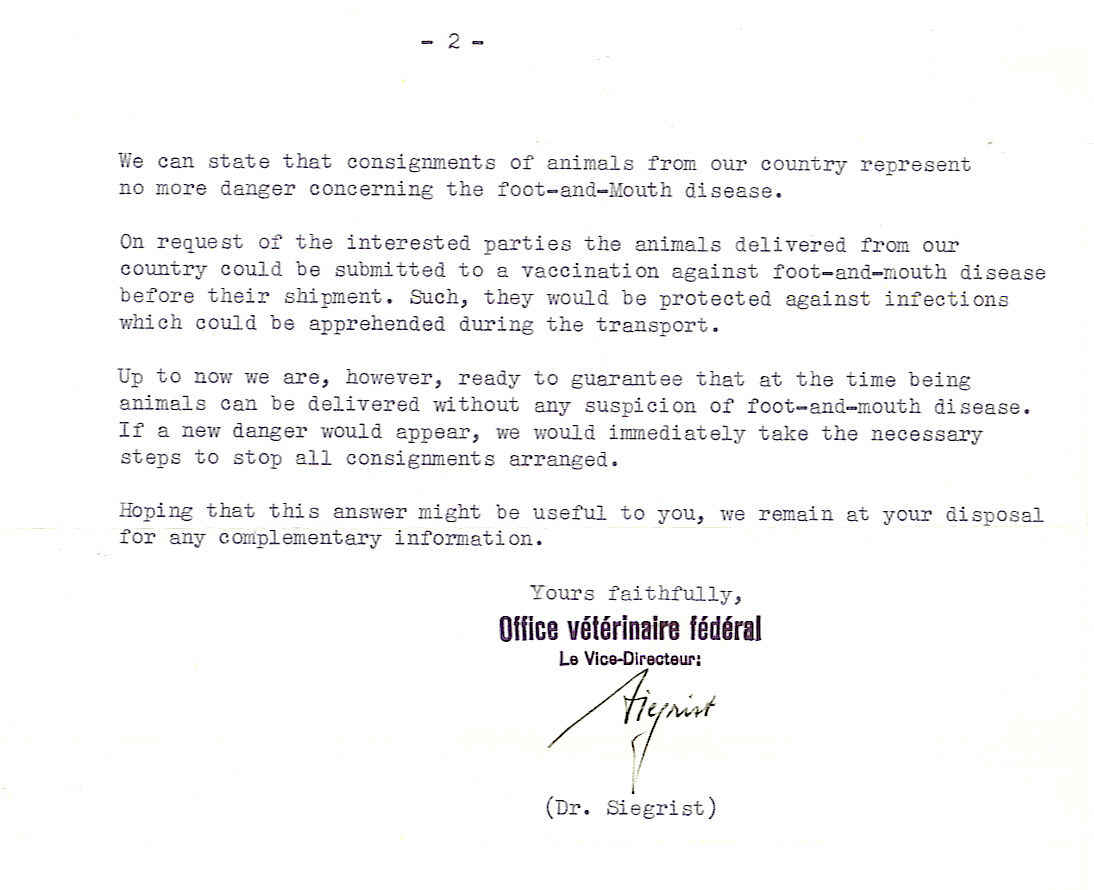


1.14: Push to Open Switzerland
(From Chp. 1 ~ 1966, titled "Foundation Work," in a book begun several years ago by SMSmith to document the early history of SBL and Simmental in North America.)
Travers had been so impressed with the cattle in Switzerland that upon his return to Canada in mid-August, he immediately set about keeping in touch with the Canadian government by telephone and correspondence, pressing for similar export allowances for Switzerland that had been granted to France. Travers sought support wherever he could. In the meantime, on faith and hope, he proceeded to direct cattle selection in Switzerland through his two Swiss contacts, trusting in their expertise and trusting that the Canadian government would come through to open Switzerland for the coming import year of 1967-68.
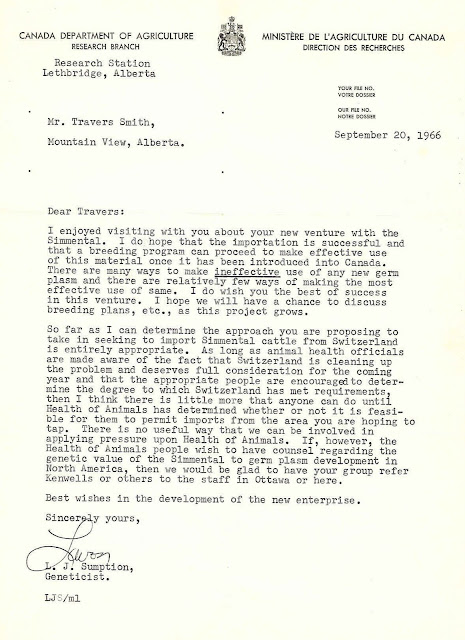
Travers had been so impressed with the cattle in Switzerland that upon his return to Canada in mid-August, he immediately set about keeping in touch with the Canadian government by telephone and correspondence, pressing for similar export allowances for Switzerland that had been granted to France. Travers sought support wherever he could. In the meantime, on faith and hope, he proceeded to direct cattle selection in Switzerland through his two Swiss contacts, trusting in their expertise and trusting that the Canadian government would come through to open Switzerland for the coming import year of 1967-68.

Friday, May 28, 2010
1:12: Home Work
(From Chp. 1 ~ 1966, titled "Foundation Work," in a book begun several years ago by SMSmith to document the early history of SBL and Simmental in North America.)
Upon arriving home, on Monday, August 15, Travers agenda was more than full. Many arrangements needed to be made, but the way was incredibly smoothed through the Canadian Charolais Association (CCA). That well-organized Association, at the request of the Canadian Department of Agriculture (CDA), took up the role of agent for all the Canadians importing from France. This involved arranging insurance and handling all matters of the Brest quarantine; chartering the ship from France to Grosse-Île; from Grosse-Île to Quebec City; and the transport thereafter by train to the West. Thus Parisien came under the well-organized, experienced Charolais umbrella, moving like clock-work from one stage of testing and quarantine to the next.


Upon arriving home, on Monday, August 15, Travers agenda was more than full. Many arrangements needed to be made, but the way was incredibly smoothed through the Canadian Charolais Association (CCA). That well-organized Association, at the request of the Canadian Department of Agriculture (CDA), took up the role of agent for all the Canadians importing from France. This involved arranging insurance and handling all matters of the Brest quarantine; chartering the ship from France to Grosse-Île; from Grosse-Île to Quebec City; and the transport thereafter by train to the West. Thus Parisien came under the well-organized, experienced Charolais umbrella, moving like clock-work from one stage of testing and quarantine to the next.
The CCA labors left Travers free to concentrate on other urgent matters.
(Below are two of several letters that Travers received from the CCA in making the many arrangements. The second letter is undated, but was probabaly written in mid- to late September 1966.)


Thursday, May 13, 2010
Canada Opens to European Imports ~ 1965
Some relevant, online archived news items & notices from Canadian veterinary journals searched out by SMS:
"Summary of Importation of Livestock into Canada"; Canadian Journal of Comparative Medicine and Veterinary Science, Vol. 26(4)—April 1962, p. iv: http://www.ncbi.nlm.nih.gov/pmc/articles/PMC1583425/pdf/vetsci00065-0002.pdf
"10 Years Ago—[Foot-and-Mouth]"; Canadian Journal of Comparative Medicine and Veterinary Science, Vol. 26(11)—Nov 1962, p. 275: http://www.ncbi.nlm.nih.gov/pmc/articles/PMC1583581/?page=1
"Livestock Import Eased"; Canadian Journal of Comparative Medicine and Veterinary Science, Vol. 29(2)—Feb 1965, p. 54; http://www.ncbi.nlm.nih.gov/pmc/articles/PMC1494368/?page=1
"Maximum Security Quarantine Station"; Canadian Journal of Comparative Medicine and Veterinary Science, Vol. 29(7)—Jul 1965. p. 191: http://www.ncbi.nlm.nih.gov/pmc/articles/PMC1494426/?page=2
"'Grosse-Ile': an overview of the island's past role in human and animal medicine in Canada" by Thomas W. Dukes; The Canadian Veterinary Journal, Vol. 42(8)–August 2001, pp. 643–648; http://www.ncbi.nlm.nih.gov/pmc/articles/PMC1476563/?page=1
"Health Tests Begin on Charolais Cattle"; Canadian Journal of Comparative Medicine and Veterinary Science, Vol. 29(10)—Oct 1965, p. 266: http://www.ncbi.nlm.nih.gov/pmc/articles/PMC1494454/?page=1
"Charolais Imports—More on the Way"; Canadian Journal of Comparative Medicine and Veterinary Science, Vol. 30(4)—April 1966, p. 117: http://www.ncbi.nlm.nih.gov/pmc/articles/PMC1494523/pdf/vetsci00017-0026.pdf
"The Cattle of the Future"; Canadian Journal of Comparative Medicine and Veterinary Science, Vol. 31(9)—Sep 1967, p. v; http://www.ncbi.nlm.nih.gov/pmc/articles/PMC1494725/?page=3
"Canadian Importation of Cattle from Europe"; Canadian Journal of Comparative Medicine, Vol. 32(3)—July 1968; http://www.ncbi.nlm.nih.gov/pmc/articles/PMC1319273/pdf/compmed00070-0002.pdf
"Summary of Importation of Livestock into Canada"; Canadian Journal of Comparative Medicine and Veterinary Science, Vol. 26(4)—April 1962, p. iv: http://www.ncbi.nlm.nih.gov/pmc/articles/PMC1583425/pdf/vetsci00065-0002.pdf
"10 Years Ago—[Foot-and-Mouth]"; Canadian Journal of Comparative Medicine and Veterinary Science, Vol. 26(11)—Nov 1962, p. 275: http://www.ncbi.nlm.nih.gov/pmc/articles/PMC1583581/?page=1
"Livestock Import Eased"; Canadian Journal of Comparative Medicine and Veterinary Science, Vol. 29(2)—Feb 1965, p. 54; http://www.ncbi.nlm.nih.gov/pmc/articles/PMC1494368/?page=1
"Maximum Security Quarantine Station"; Canadian Journal of Comparative Medicine and Veterinary Science, Vol. 29(7)—Jul 1965. p. 191: http://www.ncbi.nlm.nih.gov/pmc/articles/PMC1494426/?page=2
"'Grosse-Ile': an overview of the island's past role in human and animal medicine in Canada" by Thomas W. Dukes; The Canadian Veterinary Journal, Vol. 42(8)–August 2001, pp. 643–648; http://www.ncbi.nlm.nih.gov/pmc/articles/PMC1476563/?page=1
"Health Tests Begin on Charolais Cattle"; Canadian Journal of Comparative Medicine and Veterinary Science, Vol. 29(10)—Oct 1965, p. 266: http://www.ncbi.nlm.nih.gov/pmc/articles/PMC1494454/?page=1
"Charolais Imports—More on the Way"; Canadian Journal of Comparative Medicine and Veterinary Science, Vol. 30(4)—April 1966, p. 117: http://www.ncbi.nlm.nih.gov/pmc/articles/PMC1494523/pdf/vetsci00017-0026.pdf
"The Cattle of the Future"; Canadian Journal of Comparative Medicine and Veterinary Science, Vol. 31(9)—Sep 1967, p. v; http://www.ncbi.nlm.nih.gov/pmc/articles/PMC1494725/?page=3
"Canadian Importation of Cattle from Europe"; Canadian Journal of Comparative Medicine, Vol. 32(3)—July 1968; http://www.ncbi.nlm.nih.gov/pmc/articles/PMC1319273/pdf/compmed00070-0002.pdf
Wednesday, May 12, 2010
1.02: The Importation Process
(From Chp. 1 ~ 1966, titled "Foundation Work," in a book begun several years ago by SMSmith to document the early history of SBL and Simmental in North America.)
Dr. Ken Well's commitment to safe, direct importation resulted in a complex and comprehensive four-stage testing and quarantine procedure.
At the first stage, importers would select unvaccinated calves from French farms, usually in July. These calves would then be subject to on-farm tests and an on-farm, 30-day quarantine under Canadian control. If they passed the on-farm tests, the calves would be moved on to the second stage—to the Maximum Quarantine Facility that Canada had negotiated the use of at Brest, France. There, the calves would be subject to more tests and another 30-day quarantine, again under Canadian control.
Upon passing this second testing, the imports would be shipped by boat from Brest, France across the Atlantic to a maximum quarantine facility that Canada had established on the small island of Grosse-Ile, Quebec, in the Gulf of St. Lawrence. This Canadian quarantine station—the third stage of testing and control—was ideally suited in its total isolation from mainland Canada. Here the calves—arriving in the fall—would be subject to a 90-day quarantine and observation period; though, in effect, the quarantine would last well beyond the 90 days because the icebound St. Lawrence did not break up till March or April. When transport became possible, the calves would be shipped by boat, along the St. Lawrence River to Quebec City, where they would be greeted by their anxious importers and shipped by rail to their farm destinations. At their Canadian farms, they would undergo the fourth and final stage—a 90-day on-farm quarantine/observation with a group of indigenous control-cattle. The idea of control cattle (also to be used on Grosse-Ile) was that these controls would have no immunity or resistance to foot-and-mouth and would contract it, if there were any threat being carried by the import.
This four-stage process would prove a rigorous and lengthy procedure, consuming about a year between the time of selection in France to the time the imports received clearance after their Canadian farm quarantine. To most importers the time required must have seemed almost unbearable, but the thorough, clearly defined procedures established by Dr. Wells and his staff, laid an indispensable foundation for all that followed.
In the words of Ted Pritchett,
-----------
1. "Maximum Quarantine" by Ted Pritchett, Simmental Country, August 1987, p. 59. For a more extensive history, see pp. 51, 54-55, 58-59.
2. For a brief history of Grosse-Ile as an animal quarantine and research facility see relevant sections of The Canadian Veterinary Journal, Vol. 42, August 2001, particularly pp. 464-467 at http://www.ncbi.nlm.nih.gov/pmc/articles/PMC1476563/?page=1
Dr. Ken Well's commitment to safe, direct importation resulted in a complex and comprehensive four-stage testing and quarantine procedure.
At the first stage, importers would select unvaccinated calves from French farms, usually in July. These calves would then be subject to on-farm tests and an on-farm, 30-day quarantine under Canadian control. If they passed the on-farm tests, the calves would be moved on to the second stage—to the Maximum Quarantine Facility that Canada had negotiated the use of at Brest, France. There, the calves would be subject to more tests and another 30-day quarantine, again under Canadian control.
Upon passing this second testing, the imports would be shipped by boat from Brest, France across the Atlantic to a maximum quarantine facility that Canada had established on the small island of Grosse-Ile, Quebec, in the Gulf of St. Lawrence. This Canadian quarantine station—the third stage of testing and control—was ideally suited in its total isolation from mainland Canada. Here the calves—arriving in the fall—would be subject to a 90-day quarantine and observation period; though, in effect, the quarantine would last well beyond the 90 days because the icebound St. Lawrence did not break up till March or April. When transport became possible, the calves would be shipped by boat, along the St. Lawrence River to Quebec City, where they would be greeted by their anxious importers and shipped by rail to their farm destinations. At their Canadian farms, they would undergo the fourth and final stage—a 90-day on-farm quarantine/observation with a group of indigenous control-cattle. The idea of control cattle (also to be used on Grosse-Ile) was that these controls would have no immunity or resistance to foot-and-mouth and would contract it, if there were any threat being carried by the import.
This four-stage process would prove a rigorous and lengthy procedure, consuming about a year between the time of selection in France to the time the imports received clearance after their Canadian farm quarantine. To most importers the time required must have seemed almost unbearable, but the thorough, clearly defined procedures established by Dr. Wells and his staff, laid an indispensable foundation for all that followed.
In the words of Ted Pritchett,
"the feat [Dr. Wells and his staff] accomplished from an animal health point of view was nothing short of remarkable, but to the public, the introduction of the Continental breeds and their impact on the North American beef industry is beyond description."1As part of the import program the Canadian government undertook to build the required Maximum Quarantine facility of its own at Grosse-Ile,2 Quebec. By 1965 the facility was ready to accommodate 120 head of cattle. Its capacity was expanded in subsequent years as demand escalated.
-----------
1. "Maximum Quarantine" by Ted Pritchett, Simmental Country, August 1987, p. 59. For a more extensive history, see pp. 51, 54-55, 58-59.
2. For a brief history of Grosse-Ile as an animal quarantine and research facility see relevant sections of The Canadian Veterinary Journal, Vol. 42, August 2001, particularly pp. 464-467 at http://www.ncbi.nlm.nih.gov/pmc/articles/PMC1476563/?page=1
Subscribe to:
Posts (Atom)


