~
Thursday, December 8, 2011
Wednesday, December 7, 2011
Tuesday, December 6, 2011
1st SBL Production Sale ~ 1974
Monday, December 5, 2011
Saturday, December 3, 2011
Innovators ~ Travers & Friends
One of the great attributes of Travers was his openness to new ideas—almost too open some might have said, but he listened and if something made sense, with facts to back it or with potential for testing, he was all for the innovation. His interest in the conformation/linear measurements theory of Karney Redman of Montana was a prime example. (Ref: theories: SC:Sep1980:20-21,24, 28)
Travers was not afraid to seek advice from others. He believed that listening to others’ ideas, expertise, and vision could “irrigate” the SBL idea and so, from day one, he sought to cultivate and irrigate every aspect of Simmental.
Don Jensen said:
And strangely, with all their European antiquity, Simmental would become the most modern of cattle for it was their introduction to North America, more than any other breed, that blew down the barriers against every one of these modern innovations. Simmental was truly a revolution that impacted the entire cattle industry in North America.
Ted Pritchett wrote:
Travers was not afraid to seek advice from others. He believed that listening to others’ ideas, expertise, and vision could “irrigate” the SBL idea and so, from day one, he sought to cultivate and irrigate every aspect of Simmental.
Don Jensen said:
Travers never went at anything half-heartedly. When things started to expand and really roll here in Canada, he knew he had the tool and he wanted to find out how to use it. He went to men like Lavon Sumption, Dr. Wiltbank and Bill Pickett down in Fort Collins for their help in designing a breeding program to find out the top genetic traits in the bull battery. In addition to this work, Dr. Wiltbank was a specialist in reproduction and he set up estrus synchronization experiments and worked with induced calving. (SC:Aug1987:44)Travers came to the Simmental idea already intrigued by the potential for crossbreeding, AI, and progeny testing—long before these were considered acceptable tools. Thus Travers was uniquely prepared to help spread the idea that “You can’t raise modern cattle with Model T methods.” (Ref: Ted Pritchett, SSh:March1974:12)
And strangely, with all their European antiquity, Simmental would become the most modern of cattle for it was their introduction to North America, more than any other breed, that blew down the barriers against every one of these modern innovations. Simmental was truly a revolution that impacted the entire cattle industry in North America.
Ted Pritchett wrote:
It all began with a dream and a dreamer. While the cattle industry lost Travers Smith, with his untimely passing in 1974, he lived to see his dream come true. He lived to see his idea, developed way back in 1965-66, grow, develop, and change the beef industry. Simmental was the first of the new breeds that led into the Golden days of the beef industry — reaching a peak in 1974. Those years, and the free flowing money, led to long lasting changes that, without that kind of money, would not have been possible. Embryo transplant, improvement in heat detection, and the widespread use of AI, became everyday operations. The widespread awareness of ROP and record keeping were all a part of this period, and became long lasting by-products of those years. (BTY’77:87)Travers’ openness seems to have been a trait shared by many who became believers in Simmental. Travers was always impressed with the quality of people drawn to the Simmental dream and he would have been immensely gratified to have read the comments of Rodney James (former Secretary of the Canadian Charolais Association; former Editor and Publisher of the Canadian Charolais Banner; and Sales Manager of Transcon Livestock), when he wrote:
The incredible advancement of the [Simmental] breed over the past twenty years in my view is only partly due to the cattle. I still believe as I did in 1971 that this breed attracted and still does, some of the best people there are out there. Simmental breeders have traditionally invited competition and most importantly enjoyed other breeders’ successes. …. (SC:Aug1987:24)
Friday, December 2, 2011
Memorials
From the Simmental Scene, March 1974:
![]() |
| The Southern Simmental magazine ~ March 1974 |
Travers may be gone from his active role in Simmental but his memory will live on in all of us who knew him as a tough, headstrong, courageous man with a streak of humility, compassion and kindness seldom encountered in any man. (p. 13)From the Simmental Shield, March 1974:
I only heard one negative comment about him in the intervening years. A Montana rancher phrased it like this: “If only he wasn’t such a lousy salesman I’d have bought 500 or maybe 1,000 ampules of Simmental semen when he first visited me. And if I had bought that much I’d be a millionaire today! Darn him anyway!” (p. 12)Belle received many kind remembrances. Miles R. McCarry, Director of Agricultural Relations at Curtiss Breeding Service in Cary, Illinois wrote of a visit he and his son made to Alberta:
Travers—although busy—dropped whatever he was doing and devoted his entire day to giving us the grand tour. / We wound up finishing supper—in Fort McLeod—after dark. … / I can think of 101 more similar incidents over the years that I was privileged to know Travers Smith. / He was a pioneer, a thinker and a doer. A busy man who never got too busy to help a friend—or show a kid a bunch of Simmentals. / A rare combination, I agree. But then, Travers Smith was a rare individual! In all sincerity, I rank him among the three or four truly great men I ever knew. (Letter: March 28, 1974)Charles R. Koch, Editor & Publisher of Koch’s North American Beef Sire Directory, wrote to Fenton Webster at SBL and said:
With his importation of Parisien he became a major figure in the development of the North American cattle industry. That importation we now know was one of the most fortuitous events of modern cattle history. It made Travers something of a modern Bakewell. And Travers carried off the honor with the calm dignity of the gentleman that he was. / My frequent visits with him at stock shows and meetings will long be remembered. … (Letter: Feb. 26, 1974)From the Montana Simmental Association Newsletter, February 19, 1974:
… It is with a great deal of sorrow that we say farewell for now, to you Travers. We know you were needed in greater pastures and we know you will do your work well beside our Greatest Cowman. We know too, that in only a short while we will be with you again, looking to your guidance as we have been guided by you for these many years. / … The wisdom and leadership you have given us while you were here will make you the Immortal Cattleman of the Century.An MSA Newsletter quoted from Travers’ 1971 letter to his children, and commented:
Occasionally, as we pass thru life, some of us are fortunate enough to have the opportunity to spend some time with great men. Those of us who were fortunate enough to spend time with Travers Smith knew a great man. Not a great man only in the field of livestock, not great because he was wise enough to import the first Simmental into North America, but great because of his love of God and his family. (MSA:March1974)
Travers' Last Days
Many who attended the Louisville, Kentucky ASA meeting did not realize how serious Travers’ condition was; yet cards and letters of appreciation poured in from people whose lives he had blessed. The eventual diagnosis was Adenocarcinoma of the large intestine which had spread throughout the abdomen and into the liver. Within seven days of the ASA Convention, Travers was gone (February 7, 1974). He was just past his 57th birthday. Many from far and near attended his funeral in Cardston, Alberta on February 11, 1974.
Harry Furgeson, D.V.M., one of the early passionate converts to Simmental and a man whom Travers valued as a friend, was one of those asked by Travers' wife to serve as an honorary pallbearer. On February 16, Harry wrote a touching letter:
Dear Belle, / You made me so very humble, so proud. / No one knew how much I loved Travers—how I looked to him for guidance, for counsel. Yet you sensed it. You made me very happy. / I never had a brother by birth—but chose my brother—Travers. He led me as only a brother can. / For the Newsletter I tried to write about him— … / I hope what I have written for my Newsletter meets with your approval. …
![]() |
| Travers funeral program ~ February 11, 1974 |
![]() |
| Swiss-carved wooden cow awarded to Travers (in absentia) at the American Simmental Association banquet of Feb. 1, 1974 surrounded by funeral flowers of Feb. 11, 1974. |
Thursday, December 1, 2011
Two other honorees at Louisville, KY ~ 1974:
~
Don Jensen & Harry Furgeson: Travers would have enjoyed joining in the recognition given to two others that same evening of February 1, 1974 in Louisville, Kentucky—men he counted as valued friends: Don Jensen of SBL who received the Southern Simmental’s award for Simmental Man of the Year; and Dr. Harry Furgeson of Anaconda, Montana who was presented with the Simmental Shield’s award for producing the best Newsletter of 1973.
![]() |
| Awarded February 1, 1974 at the ASA meeting in Louisville, Kentucky |
Wednesday, November 30, 2011
ASA Tribute ~ February 1974
[Written by B.Y. Williams; read by Art Linkletter, February 1, 1974, Louisville, Kentucky]
Success is often the baby of failure, tough going and hard times — in short, perhaps better called adversity. The contribution made by Travers Smith to the revolutionizing of the cattle industry in North America through his introduction of the Simmental breed, which proved so successful that it precipitated the stampede into Exotics — was not an exception.
The writer was Manager of a Credit Union and well acquainted with Travers’ banker across the street, but as the old gag goes, “he held no hard feelings against us for keeping him in the cattle business.” I was also in cattle in a small way, and we often discussed the adversities of the business, the virtues of the native breeds — and lack of them — and how to make a living out of a beautiful, big, fat “ideal” Hereford cow that turned in a scrawny 350 pound calf at weaning time. Well, Travers’ contention was that the “egg heads” were all wrong. Presumptuous, of course. Generations of “improvement in the breed” through the theory that the prettiest cow was necessarily the most valuable had downgraded our native breeds to a financial catastrophe. Travers’ contention was that judges of cattle shows should have been judging Miss America contests. Judging cattle by type instead of performance was our ruination, and he found something right at that time to back him up.
The writer, as well as H. J. Blackmore, friend and neighbor, had done some A.I. crossbreeding with Brown Swiss. “Jim” had a three-quarter Brown Swiss bull calf that showed such phenomenal growth that he asked Travers to weigh him with a bunch Travers had on test out of the best Herefords he could find. Result — the ¾ Brown Swiss x ¼ Hereford March calf weaned 878 pounds on November 14, and the heaviest calf Travers had weaned 525 pounds.
Charolais had opened up imports from France the year before. It was January in ‘66. It was a typical day for chewing the fat — there wasn’t much on the cows — but there is always a bit of time for what is better known in the cattle industry as “shooting the bull,” and we decided in that little bull session to shoot off an application to Ottawa and see if a Brown Swiss Bull wasn’t just as importable as a Charolais.
This letter was just being sealed up and stamped the next day when in comes Travers with a full head of steam. “Hold everything, we’ve got the wrong breed. That application should be for a Simmental.” “A what?” says I. “Say man this application is for an import from France, a cattle import, not from South Africa. Simmental — that’s some kind of Gazelle, isn’t it?” “Look,” says Travers, “I didn’t know any more about them than you do till I picked up this magazine today, and here’s an article by Charley Redd, and another by Bert Hargraves, that just happens to say that Simmentals are the best damn cattle in all of Europe, if not the world.”
I grabbed my dictionary — nothing. I grabbed an encyclopedia — nothing. Oh, yes! just over the page under dairy cattle was one sentence. It said something like “a dual purpose breed native to Switzerland.” “Umph,” I said. “Those two guys should know what they’re talking about even if the encyclopedia doesn’t. We’ll never get a permit any way, so here goes,” and the letter headed for Ottawa for a permit to import one Simmental Bull, whatever that might be.
That was that. No answer — in fact we forgot about it until the middle of June. Travers dropped in one day and I said, “Didn’t those guys in Ottawa ever reply to the application we sent off?” “Never a word,” says he. “Well, I’ll be! — I’ll bet we can write a letter they will reply to anyway.” And we did.
Two days later Travers got, a telephone call from Ottawa with apologies and the information that due to an error, his permit application had been overlooked but had been granted. He had until August the 8th to have his calf in farm quarantine in France. Not much time. Five thousand bucks quick, and something to back it up with as needed, and a bull required within less than six weeks. We had no problem with money at the time, not having any. We just decided to raise $500.00 each and get the same amount from a like number of friends, and we were in business.
Travers had contacted Charley Redd previously and he had said, “If you ever get a permit, I want to pick the bull for you.” So Travers got on the phone. No dice. Charley Redd’s calendar was full, so Travers booked the next suitable reservation he could get, as I recall it, for Berne, Switzerland. Switzerland wasn’t open at the time for export, but he wanted a look at the native breed in the country of origin. He told me later that he got acquainted with the Swiss Cattle Breeders’ Federation officials, and then crossed the border into France.
Enter PARISIEN, The Simmental sire of sires, the only million dollar bull in North America. Travers hunted the country for an available bull calf under nine months of age, which had not been vaccinated for foot and mouth disease, both requirements for export. He finally found one, just barely in time to meet the deadline for entering quarantine. It was Parisien or nothing. So that was it. A curious combination of circumstances, luck, tenacity, judgment, courage, and adherence to an idea and an ideal — better cattle.
As anybody knows who has imported cattle from Europe over the years, cattle, like people, fed on and by bureaucracy, don’t seem to thrive. Parisian arrived in April of 1967, a long geared, well spotted, leggy, THIN critter, but growthy. Travers pulled him into Cardston, Alberta about noon one day, and the “knowing” cattlemen had themselves a good laugh. He was promptly dubbed “The red and white Holstein.”
There have been a lot of laughs since that time — cattlemen counting profits from Simmental.
THANKS, TRAVERS, AND A TRIBUTE TO YOU FOR YOUR IDEA AND YOUR IDEALS.
Success is often the baby of failure, tough going and hard times — in short, perhaps better called adversity. The contribution made by Travers Smith to the revolutionizing of the cattle industry in North America through his introduction of the Simmental breed, which proved so successful that it precipitated the stampede into Exotics — was not an exception.
The writer was Manager of a Credit Union and well acquainted with Travers’ banker across the street, but as the old gag goes, “he held no hard feelings against us for keeping him in the cattle business.” I was also in cattle in a small way, and we often discussed the adversities of the business, the virtues of the native breeds — and lack of them — and how to make a living out of a beautiful, big, fat “ideal” Hereford cow that turned in a scrawny 350 pound calf at weaning time. Well, Travers’ contention was that the “egg heads” were all wrong. Presumptuous, of course. Generations of “improvement in the breed” through the theory that the prettiest cow was necessarily the most valuable had downgraded our native breeds to a financial catastrophe. Travers’ contention was that judges of cattle shows should have been judging Miss America contests. Judging cattle by type instead of performance was our ruination, and he found something right at that time to back him up.
The writer, as well as H. J. Blackmore, friend and neighbor, had done some A.I. crossbreeding with Brown Swiss. “Jim” had a three-quarter Brown Swiss bull calf that showed such phenomenal growth that he asked Travers to weigh him with a bunch Travers had on test out of the best Herefords he could find. Result — the ¾ Brown Swiss x ¼ Hereford March calf weaned 878 pounds on November 14, and the heaviest calf Travers had weaned 525 pounds.
Charolais had opened up imports from France the year before. It was January in ‘66. It was a typical day for chewing the fat — there wasn’t much on the cows — but there is always a bit of time for what is better known in the cattle industry as “shooting the bull,” and we decided in that little bull session to shoot off an application to Ottawa and see if a Brown Swiss Bull wasn’t just as importable as a Charolais.
This letter was just being sealed up and stamped the next day when in comes Travers with a full head of steam. “Hold everything, we’ve got the wrong breed. That application should be for a Simmental.” “A what?” says I. “Say man this application is for an import from France, a cattle import, not from South Africa. Simmental — that’s some kind of Gazelle, isn’t it?” “Look,” says Travers, “I didn’t know any more about them than you do till I picked up this magazine today, and here’s an article by Charley Redd, and another by Bert Hargraves, that just happens to say that Simmentals are the best damn cattle in all of Europe, if not the world.”
I grabbed my dictionary — nothing. I grabbed an encyclopedia — nothing. Oh, yes! just over the page under dairy cattle was one sentence. It said something like “a dual purpose breed native to Switzerland.” “Umph,” I said. “Those two guys should know what they’re talking about even if the encyclopedia doesn’t. We’ll never get a permit any way, so here goes,” and the letter headed for Ottawa for a permit to import one Simmental Bull, whatever that might be.
That was that. No answer — in fact we forgot about it until the middle of June. Travers dropped in one day and I said, “Didn’t those guys in Ottawa ever reply to the application we sent off?” “Never a word,” says he. “Well, I’ll be! — I’ll bet we can write a letter they will reply to anyway.” And we did.
Two days later Travers got, a telephone call from Ottawa with apologies and the information that due to an error, his permit application had been overlooked but had been granted. He had until August the 8th to have his calf in farm quarantine in France. Not much time. Five thousand bucks quick, and something to back it up with as needed, and a bull required within less than six weeks. We had no problem with money at the time, not having any. We just decided to raise $500.00 each and get the same amount from a like number of friends, and we were in business.
Travers had contacted Charley Redd previously and he had said, “If you ever get a permit, I want to pick the bull for you.” So Travers got on the phone. No dice. Charley Redd’s calendar was full, so Travers booked the next suitable reservation he could get, as I recall it, for Berne, Switzerland. Switzerland wasn’t open at the time for export, but he wanted a look at the native breed in the country of origin. He told me later that he got acquainted with the Swiss Cattle Breeders’ Federation officials, and then crossed the border into France.
Enter PARISIEN, The Simmental sire of sires, the only million dollar bull in North America. Travers hunted the country for an available bull calf under nine months of age, which had not been vaccinated for foot and mouth disease, both requirements for export. He finally found one, just barely in time to meet the deadline for entering quarantine. It was Parisien or nothing. So that was it. A curious combination of circumstances, luck, tenacity, judgment, courage, and adherence to an idea and an ideal — better cattle.
As anybody knows who has imported cattle from Europe over the years, cattle, like people, fed on and by bureaucracy, don’t seem to thrive. Parisian arrived in April of 1967, a long geared, well spotted, leggy, THIN critter, but growthy. Travers pulled him into Cardston, Alberta about noon one day, and the “knowing” cattlemen had themselves a good laugh. He was promptly dubbed “The red and white Holstein.”
There have been a lot of laughs since that time — cattlemen counting profits from Simmental.
THANKS, TRAVERS, AND A TRIBUTE TO YOU FOR YOUR IDEA AND YOUR IDEALS.
Labels:
ASA,
Blackmore,
Parisien,
Recognitions,
Redd,
Travers,
Williams-BY
Tuesday, November 29, 2011
Recognitions
Travers’ untiring efforts to advance the acceptance of the remarkable Simmental breed in North America soon brought him recognition throughout Canada and the U.S. In the space of seven years, he travelled to hundreds of cities, small towns, and rural living rooms to preach the good news of Simmental. He was the featured speaker at many functions and the recipient of many awards and honors. Four are noted below:
Since Travers’ prayers for recovery were not granted, he composed a message for Belle to send to the gathering that would be honoring him. Belle’s handwritten draft reads:
Art Linkletter, the radio-TV showman and breeder of Simmentals at his Perth Australia ranch read the tribute to Travers (see a later post) that had been written by B.Y. Williams, one of the first investors in SBL. A standing ovation followed the tribute.
▪ In March 1973, he was honored at BYU and received a plaque inscribed with the words: “Recognition Award For Service To Agriculture, Travers Smith 1973, Brigham Young University Biological And Agricultural Sciences.” The speech presenting him read in part: Travers’s unceasing efforts between 1968 and 1972 to extol the virtues of the Simmental cattle is in large measure responsible for the so-called “Exotic” cattle revolution in North America. / We recognize you, Travers Smith, for your contributions to beef cattle improvements in North America. We acknowledge you as a friend of agriculture at Brigham Young University and present this token of appreciation to you for your lectures and participation during Ag. Week 1973.Travers & Belle were not present at that ASA Convention in Louisville, Kentucky, because the day after Travers mailed acceptance to their letter of invitation he was hospitalized. Despite the eventual diagnosis, Travers had great hopes that he would be healed and be able to attend—to be once again among his friends and fellow-believers in Simmental.
▪ At the 4th Annual Meeting of the Montana Simmental Association, Travers was made an honorary member and presented with an engraved trophy-clock. An account in the Simmental Shield of February 1974 reads: [Travers] accepted the award with great humility. Thanks for coming, Travers. (p. 136)
▪ The Canadian Simmental Association presented Travers with a plaque and gavel in recognition of his service as the 1st CSA president.
▪ At the American Simmental Association 6th Annual Convention and Banquet in Louisville, Kentucky, Travers was honored on February 1, 1974 and presented in absentia with a hand-carved wooden Simmental cow from Switzerland. His letter of invitation had read in part: Our Board of Trustees voted unanimously at their last meeting to present you with an award for outstanding service to the American Simmental Association.
Since Travers’ prayers for recovery were not granted, he composed a message for Belle to send to the gathering that would be honoring him. Belle’s handwritten draft reads:
To Pres. Dale Cutler, all directors, members of A.S.A and all others gathered from Canada and throughout the world. / Praying as I have always done, that God will direct our national, civic and personal lives in attaining a greater performance in service to our fellowmen. / Let us put forth our efforts this night and always to work in this direction, not forgetting that if we do this the blessings of today are but a small portion of what Jesus Christ Our Lord has in store for us both temporally and spiritually. / Let us go now and not fail Him. / Travers Smith.Noted on the bottom of the draft were the words: Telegram sent to Dale Cutler at the A.S.A Convention the night of Jan 30th 1974.
Art Linkletter, the radio-TV showman and breeder of Simmentals at his Perth Australia ranch read the tribute to Travers (see a later post) that had been written by B.Y. Williams, one of the first investors in SBL. A standing ovation followed the tribute.
Universal Semen Service Ltd.
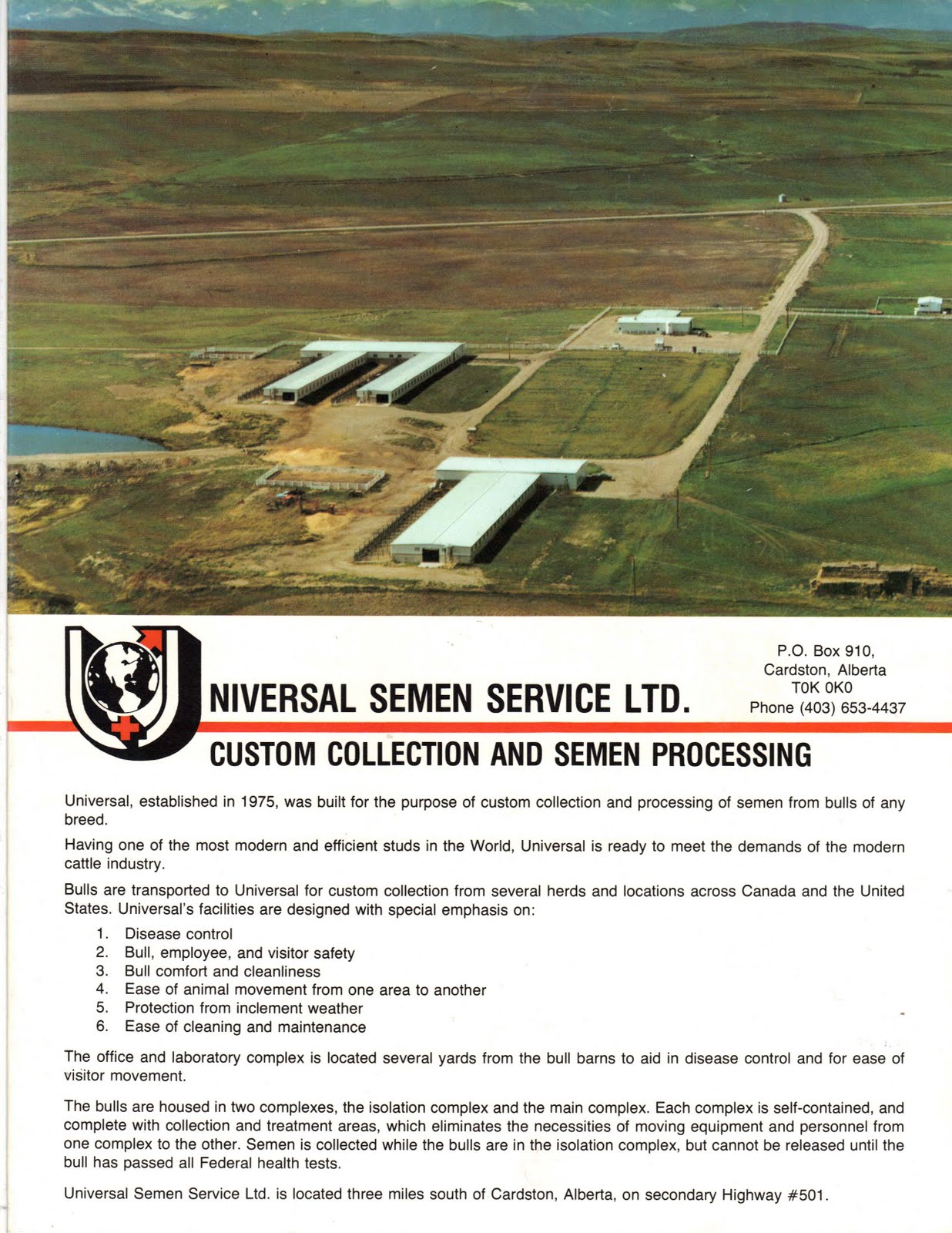
Meanwhile, despite some internal problems, the work of SBL continued. One on-going concern was to ensure the best possible handling and promotion of their bulls. Because the main focus of private bull studs was often to promote their own bulls, SBL decided in 1972 to build a first-class commercial bull stud that would be available for the top performing bulls in every breed.
This demand for bull studs was fairly new, arising about 1967 with the importation of European bulls. SBL director Frank Smith recalled those days in an interview with the Canadian Livestock Journal (Tue., July 11, 1978):
Construction was begun in 1974 and it began operation in 1975. The result was Universal Semen Service—a state-of-the-art facility located just south of Cardston. Not only did this give SBL both financial and physical control of its valuable bulls, it also provided a much-needed custom facility for other breeders. From “SBL Means Simmental” by Don Sylvester, we read about SBL’s commitment to quality.
This demand for bull studs was fairly new, arising about 1967 with the importation of European bulls. SBL director Frank Smith recalled those days in an interview with the Canadian Livestock Journal (Tue., July 11, 1978):
“Units sprang up overnight because of this demand,” Frank relates, “We had bulls in stud stations in Canada and the U.S.. The quality of the service varied. We became concerned over the safety of the bulls and of the men handling them.” / This sparked the idea of setting up a stud station. This decision was made late in 1972. … / “[As well] poor quality semen results in financial loss to ranchers. We had experienced this ourselves. Our main objective was to produce top quality semen,” Smith affirms. (“Eleven years later Parisien is still making history” by Edgar Bain)Over the next year, SBL did considerable research. They looked at stud stations in the U.S. and Canada intent on designing a facility that would be unique in construction—focusing on the safety of both bulls and handlers and on the speedy collection of top-quality semen. They found the man they wished to spearhead the project and to supervise construction—Dr. Merlin Gebauer whose doctorate was in reproductive technology.
Construction was begun in 1974 and it began operation in 1975. The result was Universal Semen Service—a state-of-the-art facility located just south of Cardston. Not only did this give SBL both financial and physical control of its valuable bulls, it also provided a much-needed custom facility for other breeders. From “SBL Means Simmental” by Don Sylvester, we read about SBL’s commitment to quality.
Dr. Gebauer says the new stud will emphasize quality control. Owners putting bulls in the stud will have to agree that semen not up to Universal’s standards will not be released. (p. 34)
Monday, November 28, 2011
Canadian Western Simmental Sale ~ 1973
Saturday, November 26, 2011
Import Selections ~ 1973-1976
1973 selections ~ two heifers (in quarantine till 1974);
1974 selections ~ four heifers (in quarantine till 1975);
1975 selections ~ two bulls (in quarantine till 1976).
1974 selections ~ four heifers (in quarantine till 1975);
1975 selections ~ two bulls (in quarantine till 1976).
Friday, November 25, 2011
Thursday, November 24, 2011
SBL Field Day ~ 1973
From “Simmental Breeders Hold Field Day” by Leland Cade in the Sept. 6, 1973 issue of the Montana Farmer-Stockman we read:
The following map is from an old printer's draft and was used in some of SBL promotional material.
Simmental Breeders, Ltd of Cardston, Alberta had a big field day recently — 600 people from quite a few states and provinces registered to view the animals, listen to speakers, take part in a big beef feed, and check their numbers for the big door prize — a half-blood Simmental heifer bred to a Simmental bull or a trip for two to the homeland of Simmental (Switzerland) plus $1,000.00 cash for incidentals.SBL was already working on developing its own bull stud. It would become know as Universal Semen Service Ltd.
Winner of the prize was Janna McMahon of Kennewick, Washington. …
Dr. Jim Wiltbank of Colorado State University was introduced as “playing a fundamental role in the development of SBL.” During the presentation he said that “Our fundamental purpose is three-fold — to identify superior Simmental bulls, to make use of these bulls in our program, and to make those bulls available for your use. … (pp. 46-7)
The following map is from an old printer's draft and was used in some of SBL promotional material.
Wednesday, November 23, 2011
ASA National Sire Summary ~ 1973
~
In the foreword of the ASA's 1973 National Sire Summary, Don Vaniman, executive secretary of the ASA, wrote, in part:
... The American Simmental Association was the first to recognize the need to improve the economic traits of cattle by informing its members of the genetic differences of its registered sires. The National Simmental Sire Summary is still the first publication of its kind ever printed by an American breed society. The others are contemplating its benefits – but the Simmental breed has actually accomplished it.Page 9 of the 116-page Summary set forth the ASA rules and percentage chart as pictured below:
This Sire Summary will completely change methods of breeding, selecting, exhibiting and selling of Simmental cattle. It will keep the honest cowman in business and eliminate the exploiter who would promote valueless bulls by hard sell advertising and sharp management practices but which would not stand up genetically in the Simmental performance testing procedures.
This Summary will not only benefit those purebred breeders who wish to become “master breeders,” instead of just “multipliers,” but will also immeasurably benefit the commercial cattleman who has to make a living by raising profitable cattle. …
This Summary is an improvement over last year and subsequent summaries will be even more meaningful. This represents only the second year of the National Simmental Sire Summary …
Tuesday, November 22, 2011
Swiss Cattle Breeders ~ Promotions
For a few years, Travers acted as the official Canadian representative of the Commission of Swiss Cattle Breeders Federations as they promoted the benefits of this new “very old” breed. Two of their ads are shown below. The publications are unknown, but believed to be from the years 1972 and 1973.
![]() |
| circa 1972 (?) |
![]() |
| circa 1973 |
Monday, November 21, 2011
The National Simmental Sale ~ 1972
The inside cover of “the National Simmental Sale at Fort Worth, Texas/February 5/1972” brochure gives some idea of the interest and growth of Simmental in just a few incredibly busy years.
Sunday, November 20, 2011
Performance Testing for Mankind
Travers' love of his God and his belief that performance testing was not just for livestock was evident to almost all who knew him. His enthusiasm for sharing his beliefs is borne out in the following accounts.
The first comes from the John Schmidt’s … agriculture Alberta column (Calgary Herald) of September 20, 1972. John Schmidt wrote about a cattlemen tour
deep into Mormon country to visit … Simmental Breeders Cardston Ltd., headed by Travers Smith. ... Following lunch, something happened which caught us off base in this computer age, but it demonstrated the fact that cattle men like Travers Smith don’t put all their faith in electronic gadgetry. There is something higher. He presented us all with The Book of Mormon, and gave this profound testimony: “There is one thing more valuable to me than that herd of cattle you saw today. It is this Book. In it you can read about the performance test of human endeavor on this earth.” It was something to make one pause and consider very deeply.The second account was recorded by Travers' eldest daughter following a December 21, 1973 conversation. On the way home from the Calgary airport, Travers told his daughters about his recent experience in Billings, Montana. His daughter wrote:
The Montana Simmental Assoc. had a conference at which they honored dad in October. ... All the men at the convention were wearing “Thank You Travers” buttons. Mr. Furgeson, the secretary of the organization said a lot, & kind of instigated the affair. When Mr. Furgeson presented Dad with the trophy[-clock] honoring him. He said Dad could answer in only 12 words. [Previously Mr. F. had given Dad a bad time about not being a good enough salesman (not talking enough)]. When Dad replied, he said that he was going to pull a switch on Mr. F. and say a lot. Dad said that the spirit there was really a good spirit so he felt moved to speak on more of a spiritual [plane]. He spoke about performance testing in cattle & compared it to us as God’s children & our performance tests. He referred them to the Bible as being our handbook for personal performance. He also expressed to them that it was by the hand of the Lord that he brought Parisien to Canada. After his testimony the men all came forward and thanked him for his talk not the cattle. The men also honored Mr. Furgeson for all that he had done to keep M.S.A. on its feet. (BYSJ:Jan 9, 1974:44-5)A third account comes from Tom and Dianne Risinger found at http://www.simmgene.com/pdf/register/40years_208.pdf :
… About the same time, we ran into Charlie Redd from Utah, who had just come back from Europe and he was raving about the Simmental cattle he saw. One day, a really nice, smart, and very intense man named Travers Smith from Cardston, Alberta, came to our house to visit with us about Simmental Cattle. He wore a suit coat with a Book of Mormon in one pocket and a photo album of Simmental cattle in the other. Here was an honest, sincere man who was definitely on a mission and believed in what he was doing. At a meeting in town that night where Travers spoke, we ordered 20 units of semen on a yellow paint calf named Parisien that, at the time, was still waiting to be released from quarantine by Canadian agricultural authorities. ...
... I’ll never forget Travers Smith. He came to visit us when we had only 40 cows and they weren’t even paid for. He had time for anyone who would listen to him. (Tom & Dianne Risinger “40 Years and counting, Part II” by Dan Rieder)
Labels:
BkMormon,
Furgeson,
Performance testing,
Recognitions,
Redd,
Religion,
Risinger,
Schmidt,
Travers
Subscribe to:
Posts (Atom)


