Monday, May 31, 2010
1.14: Push to Open Switzerland
(From Chp. 1 ~ 1966, titled "Foundation Work," in a book begun several years ago by SMSmith to document the early history of SBL and Simmental in North America.)
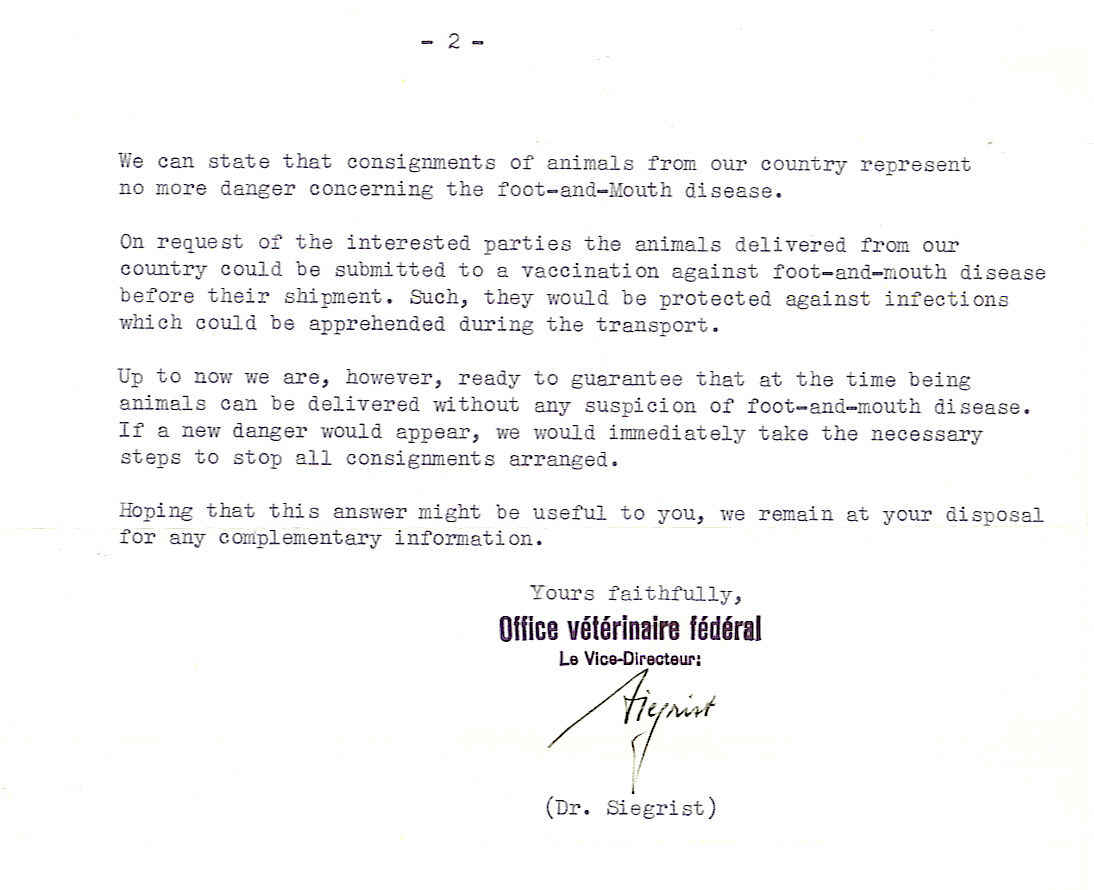
Travers had been so impressed with the cattle in Switzerland that upon his return to Canada in mid-August, he immediately set about keeping in touch with the Canadian government by telephone and correspondence, pressing for similar export allowances for Switzerland that had been granted to France. Travers sought support wherever he could. In the meantime, on faith and hope, he proceeded to direct cattle selection in Switzerland through his two Swiss contacts, trusting in their expertise and trusting that the Canadian government would come through to open Switzerland for the coming import year of 1967-68.
Saturday, May 29, 2010
1:13: SBL (Simmental Breeders Limited)
(From Chp. 1 ~ 1966, titled "Foundation Work," in a book begun several years ago by SMSmith to document the early history of SBL and Simmental in North America.)
Another priority that summer and fall of 1966 was to organize the group of local investors who had responded to Travers' enthusiasm as he described what he envisioned the Simmental breed could do to increase productivity, performance, and profitability in their livestock operations. By August 1966, seven men had committed to help Travers finance this venture that had so captured Travers' focus. On August 30, six of the eight initial contributors of capital met to determine the type of organization they would establish to transact the future business of the contributing group. Those present at the meeting were:
B. Travers Smith; Dr. Orson T. Bingham; Harold Watson; Guy Bowlby; H.J. Blackmore*; B.Y. Williams
Those absent were: Dr. S. B. Williams; Franklyn Smith
Each contributor's investment was $500.00 in cash with a further $500.00 guarantee to the bank for a $4,000.00 loan.
The name of the company was determined to be Simmental Breeders Limited,1 and direction was given for its incorporation which took place on September 26, 1966.
Chairman: B. Travers Smith
Secretary; B.Y. Williams
Dr. Orson T. Bingham was a Cardston dentist who ran cattle on the side.
Harold Watson was a rancher with some farming interests who lived at Mt. View and was brother-in-law to Travers Smith.
Guy Bowlby was a rancher living at Twin Butte, AB.*J.H. (James Horn) Blackmore (aka-Hastings James or H.J.) was a cattle rancher based in Leavitt & Mountain View
B.Y. Williams was manager of the Cardston Credit Union and rancher.
Dr. S.B. Williams was a Cardston dentist, with cattle interests on the side.
Frank Smith was a cattle rancher at Mt. View, AB, and brother to Travers.
There were others that Travers invited to join the venture, but who, for various reasons, were not ready, willing, or able to take the risks that certainly attended such an investment. This new breed of cattle was essentially unheard of in North America. For some, the performance facts of Simmental seemed to-good-to-be-true. If the Simmental were so good, why hadn't someone found a way to get them in long ago? The fact they were not in North America when their reputation for quality and performance were so widely and anciently recognized throughout the rest of the world was amazing to Travers, too. It seemed impossible that no one had found a way to get them here.
The first SBL logo was adopted about 1970.
(Phone and address are not longer valid as company no longer exists.)
---------/
1. On 25 July 1969 the company's name was changed to Simmental Breeders Cardston Limited, but it would always be known as SBL. (Ref.: Alberta corporate registry search).
Friday, May 28, 2010
1:12: Home Work
(From Chp. 1 ~ 1966, titled "Foundation Work," in a book begun several years ago by SMSmith to document the early history of SBL and Simmental in North America.)
Upon arriving home, on Monday, August 15, Travers agenda was more than full. Many arrangements needed to be made, but the way was incredibly smoothed through the Canadian Charolais Association (CCA). That well-organized Association, at the request of the Canadian Department of Agriculture (CDA), took up the role of agent for all the Canadians importing from France. This involved arranging insurance and handling all matters of the Brest quarantine; chartering the ship from France to Grosse-Île; from Grosse-Île to Quebec City; and the transport thereafter by train to the West. Thus Parisien came under the well-organized, experienced Charolais umbrella, moving like clock-work from one stage of testing and quarantine to the next.
The CCA labors left Travers free to concentrate on other urgent matters.
(Below are two of several letters that Travers received from the CCA in making the many arrangements. The second letter is undated, but was probabaly written in mid- to late September 1966.)
Thursday, May 27, 2010
1.11: Return to Switzerland (August 7-12, 1966)
(From Chp. 1 ~ 1966, titled "Foundation Work," in a book begun several years ago by SMSmith to document the early history of SBL and Simmental in North America.)
With the finding of Parisien, Travers' main mission was now accomplished, but he was still full of his Swiss dreams. He needed more time in Switzerland. He missed his Saturday night train to Berne, so he left Paris for Berne on Sunday morning, August 7, arriving in time to attend his evening religious services in the same chapel he had attended one week previous.
The week of August 8-12 was spent in Switzerland. Travers wrote that he spent his time
1. "Selecting the First Canadian Simmentals," by Travers Smith, Simmemtal Shield, October 1970, pp. 8-10, quote from page 9.
With the finding of Parisien, Travers' main mission was now accomplished, but he was still full of his Swiss dreams. He needed more time in Switzerland. He missed his Saturday night train to Berne, so he left Paris for Berne on Sunday morning, August 7, arriving in time to attend his evening religious services in the same chapel he had attended one week previous.
The week of August 8-12 was spent in Switzerland. Travers wrote that he spent his time
… making arrangements for the future, contacting all the government and export people possible, as well as their veterinarians. My inquiries for top quality cattlemen in Switzerland to do a selection job for us in the future led me to two persons—Ernst Aegerter, who had for most of his life headed up the export of cattle out of Switzerland, and a Mrs. Ida Hofer, who was a real cattlewoman in her own right, being of a famous cattle breeding family in Switzerland and also married into one.1In a letter to his chidren under date of October 31, 1971, Travers, a deeply religious man who believed in God's governance in the lives of all people, wrote of this experience in selecting Parisien:
[God] led me to the right people in Switzerland, in France, unbeknown to them He influenced men to organize trips for me to see cattle. He gave me ideas and understanding of Cattle and the attendant business far beyond my natural powers. In the past He prepared through mens management of Genetics a Bull that started the biggest revolution for good in the cattle industry on this continent.---------/
1. "Selecting the First Canadian Simmentals," by Travers Smith, Simmemtal Shield, October 1970, pp. 8-10, quote from page 9.
Wednesday, May 26, 2010
Parisien's Genetics
This chart is on the reverse of a Curtiss Breeding Service Inc., Curtiss Farm, Cary, Illinois promotional sheet for Parisien.
Parisien's Dam
This picture was probably taken sometime between 1968 and 1973. The photographer is unknown.
Uree-Etoile (Parisien's dam), Travers Smith and a French cattleman
Tuesday, May 25, 2010
S.E.P.A. Contract ~ Parisien (August 6, 1966)
Note: there is a prior document also dated 6 August 1966, but unsigned by the parties that shows a "Farm Price" of 15.000 Frs for Parisien and 14.000 Frs each for the alternates, but the price was negogiated upwards to that shown on the signed document. The reasoning is explained in Tavers' letter of Oct. 18, 1966 to be posted hereafter: post title, "1.15: Parisien ~ Payment."
1.10: Finding Parisien (Friday, August 5, 1966)
(From Chp. 1 ~ 1966, titled "Foundation Work," in a book begun several years ago by SMSmith to document the early history of SBL and Simmental in North America.)
The next 5 days were a whirlwind of activity. Back in Paris by Tuesday morning, August 2, Travers sought out more information on promising herd sites. Both the Swiss cattle people and Canadian Embassy officials directed him to the Pie Rouge (French Simmental) Herd Book at Dijon, France, so by 3 P.M. Tuesday, Travers was in Dijon where the Pie Rouge Cattle Registry people undertook to arrange a tour for the following morning.
There in Dijon at the Herd Registry, Wayne Malmberg, the first Charolais importer, and Ray Woodward, "one of the best Genetists in the U.S." caught up with Travers via telephone. Malmberg and Woodward were in France buying Charolais cattle, but as they had attempted some ground work on the Simmental cattle for Travers, they were interested in meeting him for the Dijon tour along with some of the S.E.P.A men (Societe d'Exportation de Produits Agricoles) of their acquaintance. They recommended tour sites as well. Thus, the next morning (Wednesday, August 3), 2 cars of "Good top men" began a Pie Rouge tour. They travelled 500 miles seeing "good cattle" all along the way. They landed back at Nevers, France that night where Malmberg and Woodward had been staying.
Next day, Thursday, August 4, before Malmberg and Woodward left for Canada, Travers was taken to see some "good Charolais cattle." But by the end of Thursday, Travers still had not seen the Simmental bull calf he was looking for. In the meantime, the Pie Rouge Association secretary had been searching the Association's records to find more unvaccinated cattle of the type Travers desired. The S.E.P.A. men too were making more contacts and on Friday morning, August 5, Travers finally saw the bull he wanted.
Travers’ letter home (Sunday, August 7) does not express his impressions of the 3 unvaccinated bull-calves he selected that Friday, August 5th, but the S.E.P.A. document dated 6 August 1966 shows his first choice as Parisien (No 15.891 c 982, born 16 February 1966), with a farm price of 17.000 Fr. Two alternate choices were required in the event that Parisien failed the health tests. The first alternative, Orkan, was from the Langenieux farm; the second, Oranais, from the Roger farm. First-choice Parisien was from the Henri Rossin farm (C 982) at Saint-Appolinaire, Cote d’Or, only five miles from the Herd Book Office of the Pie Rouge at Dijon.
With the S.E.P.A. documents signed, the animals with their dams were set to enter the requisite testing area on Monday, August 8, 1966, the deadline given by the Canada Department of Agriculture. Travers had beaten the deadline by one day, a Sunday.
First, would came the “on-farm” test and 30-day quarantine. Passing those tests Parisien would be moved on to the quarantine station at Brest, France for more tests and another 30-day quarantine under Canadian control. Passing those tests, Parisien (along with all the Canadian-bound Charolais imports) would be placed on a ship bound for Canada’s quarantine facility at Grosse-Île, Quebec, an island in the Gulf of Saint Lawrence.
Things were now in process.
The next 5 days were a whirlwind of activity. Back in Paris by Tuesday morning, August 2, Travers sought out more information on promising herd sites. Both the Swiss cattle people and Canadian Embassy officials directed him to the Pie Rouge (French Simmental) Herd Book at Dijon, France, so by 3 P.M. Tuesday, Travers was in Dijon where the Pie Rouge Cattle Registry people undertook to arrange a tour for the following morning.
There in Dijon at the Herd Registry, Wayne Malmberg, the first Charolais importer, and Ray Woodward, "one of the best Genetists in the U.S." caught up with Travers via telephone. Malmberg and Woodward were in France buying Charolais cattle, but as they had attempted some ground work on the Simmental cattle for Travers, they were interested in meeting him for the Dijon tour along with some of the S.E.P.A men (Societe d'Exportation de Produits Agricoles) of their acquaintance. They recommended tour sites as well. Thus, the next morning (Wednesday, August 3), 2 cars of "Good top men" began a Pie Rouge tour. They travelled 500 miles seeing "good cattle" all along the way. They landed back at Nevers, France that night where Malmberg and Woodward had been staying.
Next day, Thursday, August 4, before Malmberg and Woodward left for Canada, Travers was taken to see some "good Charolais cattle." But by the end of Thursday, Travers still had not seen the Simmental bull calf he was looking for. In the meantime, the Pie Rouge Association secretary had been searching the Association's records to find more unvaccinated cattle of the type Travers desired. The S.E.P.A. men too were making more contacts and on Friday morning, August 5, Travers finally saw the bull he wanted.
Travers’ letter home (Sunday, August 7) does not express his impressions of the 3 unvaccinated bull-calves he selected that Friday, August 5th, but the S.E.P.A. document dated 6 August 1966 shows his first choice as Parisien (No 15.891 c 982, born 16 February 1966), with a farm price of 17.000 Fr. Two alternate choices were required in the event that Parisien failed the health tests. The first alternative, Orkan, was from the Langenieux farm; the second, Oranais, from the Roger farm. First-choice Parisien was from the Henri Rossin farm (C 982) at Saint-Appolinaire, Cote d’Or, only five miles from the Herd Book Office of the Pie Rouge at Dijon.
With the S.E.P.A. documents signed, the animals with their dams were set to enter the requisite testing area on Monday, August 8, 1966, the deadline given by the Canada Department of Agriculture. Travers had beaten the deadline by one day, a Sunday.
First, would came the “on-farm” test and 30-day quarantine. Passing those tests Parisien would be moved on to the quarantine station at Brest, France for more tests and another 30-day quarantine under Canadian control. Passing those tests, Parisien (along with all the Canadian-bound Charolais imports) would be placed on a ship bound for Canada’s quarantine facility at Grosse-Île, Quebec, an island in the Gulf of Saint Lawrence.
Things were now in process.
Monday, May 24, 2010
1.09: "Most Magnificent Cattle"
(From Chp. 1 ~ 1966, titled "Foundation Work," in a book begun several years ago by SMSmith to document the early history of SBL and Simmental in North America.)
By going to Switzerland first, Travers also hoped to get what advice he could on best selection criteria and farm locations in France from the Swiss. Because of his delayed flight from Paris, the Swiss Cattle Commission offices were closed by the time of his arrival. The next morning (Saturday), he found their offices closed for the weekend, but was finally able to roust a young man in the building to open up to him. The young man was very helpful in arranging for a cattle guide and Travers was soon on his way by train to Spiez to meet his guide to the Simmental (both cattle and valley). His guide was Mrs. Hofer, a middle-aged widow who spoke 5 languages. Her husband had died about five years previous, but as they had raised Simmental Cattle, she “knew all about them, where to go, and the people to see.”
On Saturday, July 30, under the guidance of Mrs. Hofer, Travers got his first view of the best Simmental cattle in the Simmental (the Simme River valley). He described them as “The most Magnificent Cattle I have ever seen.”1
On Monday morning, August 1, Travers left for Geneva, Switzerland arriving about noon where he met a Mr. Roger Decre, an importer and exporter of cattle between Switzerland and France. Travers spent 2-3 hours with Mr. Decre at the Swiss/French border while Mr. Decre cleared cattle. From there they travelled to Mr. Decre's Mountain Ranch near Gex, France looking at cattle all day. By 11 P.M. Travers was back in Geneva, Switzerland, boarding the train for Paris.
---------------
1. Letter to his wife, Belle, July 31, 1966: (BFS-5)
2. Simmental Shield, Oct 1970:8
3. Letter to B.Y. Williams, July 31, 1966: (BYW-2)
By going to Switzerland first, Travers also hoped to get what advice he could on best selection criteria and farm locations in France from the Swiss. Because of his delayed flight from Paris, the Swiss Cattle Commission offices were closed by the time of his arrival. The next morning (Saturday), he found their offices closed for the weekend, but was finally able to roust a young man in the building to open up to him. The young man was very helpful in arranging for a cattle guide and Travers was soon on his way by train to Spiez to meet his guide to the Simmental (both cattle and valley). His guide was Mrs. Hofer, a middle-aged widow who spoke 5 languages. Her husband had died about five years previous, but as they had raised Simmental Cattle, she “knew all about them, where to go, and the people to see.”
On Saturday, July 30, under the guidance of Mrs. Hofer, Travers got his first view of the best Simmental cattle in the Simmental (the Simme River valley). He described them as “The most Magnificent Cattle I have ever seen.”1
I spent some hours with a tape measure measuring these cattle and jotting down the figures and just standing and looking at them. It took some time to pull myself away from this scene.2In his July 31 letter to colleague, B.Y. Williams of Cardston, Travers wrote:
I can’t get over them. We can’t get his kind of animal in 100’s of years of breeding with what we’ve got to work with in Canada. If we can get a few over home it will be the biggest break through for Cattle in a long time. … I’m making every effort and contacted [sic] possible to see if we can’t move cattle from here to France for another year. // … I would sell ½ my herd to get a few of these over.3His plans were to stay in Switzerland till Monday or Tuesday before returning to France to select his import animal, a Red and White Simmental [Pie rouge de l'Est]. On Sunday, July 31, after a morning sick-and-dizzy spell (which he attributed to a delayed vaccination reaction: BFS-5), Travers took time to attend his religious services at the LDS Chapel next to the LDS Swiss Temple. Between church meetings, he visited with one of his new acquaintances, Dr. Winzenried, whose farm was located 1½ miles from the LDS meetinghouse.
On Monday morning, August 1, Travers left for Geneva, Switzerland arriving about noon where he met a Mr. Roger Decre, an importer and exporter of cattle between Switzerland and France. Travers spent 2-3 hours with Mr. Decre at the Swiss/French border while Mr. Decre cleared cattle. From there they travelled to Mr. Decre's Mountain Ranch near Gex, France looking at cattle all day. By 11 P.M. Travers was back in Geneva, Switzerland, boarding the train for Paris.
---------------
1. Letter to his wife, Belle, July 31, 1966: (BFS-5)
2. Simmental Shield, Oct 1970:8
3. Letter to B.Y. Williams, July 31, 1966: (BYW-2)
Saturday, May 22, 2010
1.08: Above the Clouds!
(From Chp. 1 ~ 1966, titled "Foundation Work," in a book begun several years ago by SMSmith to document the early history of SBL and Simmental in North America.)
After receiving the "permit" news, precious time elapsed before all arrangements were made, but on Wednesday, July 27, 1966 Travers boarded his flight in Lethbridge, Alberta bound for France and Switzerland. He didn’t even have his passport yet, but felt confident he could pick it up during his 5-hour stopover in Ottawa (reduced to 3 hours because of delays). He got his passport without undue complications (crediting his God for “softening the heart of the customs man”) and by Thursday, July 28 at 6:30 P.M., he was waiting in Montreal for his flight to France. In the space of little more than one day, his flight had stopped in Calgary, Winnipeg, Toronto, Ottawa, and Montreal.
This was Travers’ first air flight, and mixed in with the thrill of this new experience, he felt a drive that would not let him rest. It was as though his life had been building for this purpose, and that no obstacle could stand against his conviction.
All along his way to Europe, he felt that through God’s providence, he met people who helped him: Dr. Sumption in Lethbridge who “gave me some good advice on Genetics”; a Mr. Russell from Lethbridge travelling to a new government assignment in Charlottetown who, “helped me out a lot”; and “some good leads” for French contacts from the Vets, and from Trades & Commerce in Ottawa. He wrote:
He arrived in Paris, France early Friday morning (July 29, 1966), but only as a stopover. His push was to get to Switzerland.
After a 6-hour unexpected delay in Paris (airline overbooking of flights), he flew on to Zurich and took the train to Bern, arriving Friday night, July 29 at 9 P.M., seven hours later than planned. His determined purpose—to first see the cattle that looked so impressive in the brochures sent by the Swiss Cattle Commission “so that I could compare the animals in France to them.”
---------------
1. Letter to colleague, B.Y. Williams, July 28, 1966: (BYW-1)
2. Letter to his wife, Belle, July 29, 1966: (BFS-4)
After receiving the "permit" news, precious time elapsed before all arrangements were made, but on Wednesday, July 27, 1966 Travers boarded his flight in Lethbridge, Alberta bound for France and Switzerland. He didn’t even have his passport yet, but felt confident he could pick it up during his 5-hour stopover in Ottawa (reduced to 3 hours because of delays). He got his passport without undue complications (crediting his God for “softening the heart of the customs man”) and by Thursday, July 28 at 6:30 P.M., he was waiting in Montreal for his flight to France. In the space of little more than one day, his flight had stopped in Calgary, Winnipeg, Toronto, Ottawa, and Montreal.
This was Travers’ first air flight, and mixed in with the thrill of this new experience, he felt a drive that would not let him rest. It was as though his life had been building for this purpose, and that no obstacle could stand against his conviction.
All along his way to Europe, he felt that through God’s providence, he met people who helped him: Dr. Sumption in Lethbridge who “gave me some good advice on Genetics”; a Mr. Russell from Lethbridge travelling to a new government assignment in Charlottetown who, “helped me out a lot”; and “some good leads” for French contacts from the Vets, and from Trades & Commerce in Ottawa. He wrote:
Vets say we may if France cooperates bring cattle from swiss. to calve in France. I'll see if France OKs this.1Travers’ first oceanic flight was
… a most beautiful sight. Billowy mass of cloud below in all shapes high and low like mountains and miles & miles of rolling like pillow cloud[s] … Something I’ve never seen and hard to describe. Has to be seen.2He was like an awe-filled explorer into an unseen, never-imagined world.
He arrived in Paris, France early Friday morning (July 29, 1966), but only as a stopover. His push was to get to Switzerland.
After a 6-hour unexpected delay in Paris (airline overbooking of flights), he flew on to Zurich and took the train to Bern, arriving Friday night, July 29 at 9 P.M., seven hours later than planned. His determined purpose—to first see the cattle that looked so impressive in the brochures sent by the Swiss Cattle Commission “so that I could compare the animals in France to them.”
---------------
1. Letter to colleague, B.Y. Williams, July 28, 1966: (BYW-1)
2. Letter to his wife, Belle, July 29, 1966: (BFS-4)
Friday, May 21, 2010
1.07: Permit ~ At Last!! (CDA - July 7, 1966)
(From Chp. 1 ~ 1966, titled "Foundation Work," in a book begun several years ago by SMSmith to document the early history of SBL and Simmental in North America.)
Amidst the flurry of continued Simmental research, Travers was anxiously awaiting word on his April 30th request for a permit.1 When the end of June approached, still without word from the CDA, Travers and B.Y. fired off another letter (29 June 1966).1 B.Y. Williams remembered it thus:
------------
1. For copies of these letters to the CDA, see post herein of May 19, 2010.
2. Simmental Shield, March 1974:30
Amidst the flurry of continued Simmental research, Travers was anxiously awaiting word on his April 30th request for a permit.1 When the end of June approached, still without word from the CDA, Travers and B.Y. fired off another letter (29 June 1966).1 B.Y. Williams remembered it thus:
Two days later Travers got a telephone call from Ottawa with apologies and the information that, due to an error, his permit application had been overlooked but had been granted. He had until August 8 to have his calf in farm quarantine in France. Not much time. Five thousand bucks quick, and something to back it up, and a bull required within less than six weeks. We had no problem with money at the time, not having any. We just decided to raise five hundred dollars each and get the same amount from a like number of friends, and we were in business. / Travers had contacted Charley Redd previously and he had said, “If you ever get a permit, I want to pick the bull for you.” So Travers got on the phone. No dice. Charley Redd’s calendar was full. So Travers booked the next suitable reservation he could get for Berne, Switzerland. Switzerland wasn’t open at the time for export, but he wanted a look at the native breed in the country of their origin.2At last, under date of July 7, 1966, Travers received his written permit for the “importation of 1 cattle from France.” He was now in a time squeeze because the Brest, France quarantine was to begin September 1. With the CDA requirement of an approximate 30-day on-farm quarantine before the Brest quarantine, he was informed that the selection had to be made no later than Monday, August 8, 1966.
------------
1. For copies of these letters to the CDA, see post herein of May 19, 2010.
2. Simmental Shield, March 1974:30
Subscribe to:
Posts (Atom)